


 English
 中文简体
中文简体 русский
Horizontal Multistage Centrifugal Pumps Guide
Content
How Horizontal Multistage Centrifugal Pumps Work
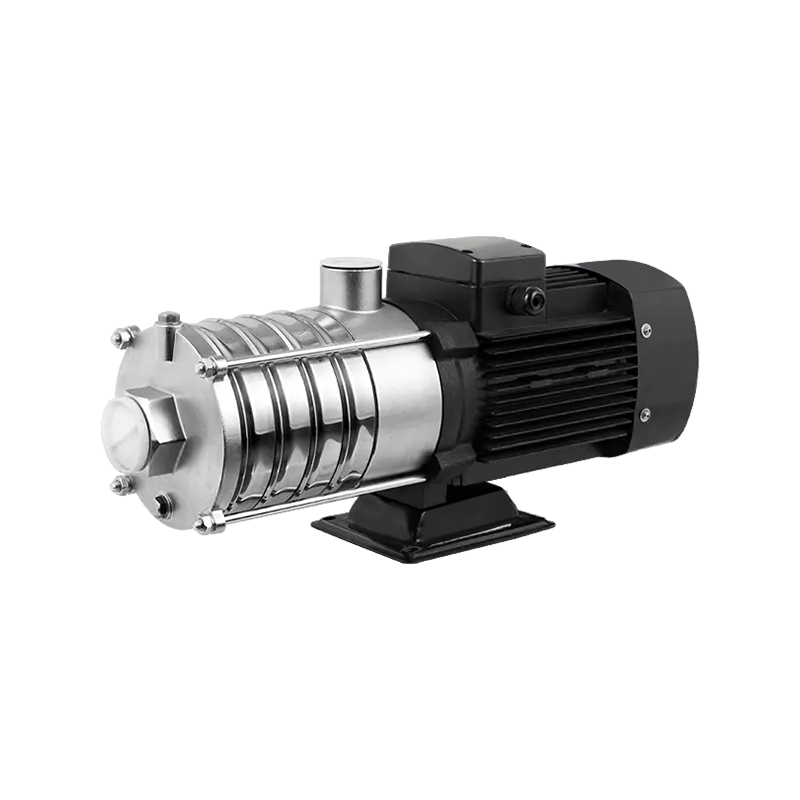
A horizontal multistage centrifugal pump is a fluid transport device built around the principle of centrifugal force. When the motor drives the impeller to rotate at high speed, the medium inside the pump casing is subjected to centrifugal force and moves outward through the passages between the blades. This continuous ejection of fluid creates a pressure differential that draws more medium into the inlet, sustaining uninterrupted flow throughout the system.
The term "multistage" refers to the arrangement of multiple impellers in series within a single pump casing. Each impeller acts as an independent stage, boosting the pressure of the fluid before passing it on to the next. This stacking of stages allows horizontal multistage centrifugal pumps to reach pressure levels that would be impossible for a single impeller to achieve alone, without requiring excessively large equipment footprints.
One structural advantage worth noting is the shorter axial length of modern horizontal centrifugal pump designs compared to traditional single-suction configurations. This compact axial profile reduces shaft deflection under load, which directly improves operational stability and lowers noise levels during continuous duty cycles — a measurable benefit in installations where vibration control matters.
Horizontal Multistage Pump vs Single Stage: A Practical Comparison
The horizontal multistage pump vs single stage debate comes down to two core variables: required head and required flow. A single-stage pump uses one impeller and is well-suited for high-flow, low-to-moderate pressure applications. A multistage pump sacrifices some flow capacity per stage in exchange for dramatically higher discharge pressure. Understanding this trade-off is essential before selecting equipment.
| Feature | Single Stage Pump | Horizontal Multistage Pump |
|---|---|---|
| Number of Impellers | 1 | 2 – 12+ (application-dependent) |
| Max Head Output | Moderate (typically up to ~100 m) | High (commonly 200 – 1,500 m) |
| Best For | High-flow, low-pressure systems | High-pressure, moderate-flow systems |
| Axial Length | Shorter | Longer (but optimized in modern designs) |
| Maintenance Complexity | Lower | Moderate (more components) |
| Noise & Vibration | Low | Low (with optimized shaft design) |
| Seal Options | Standard mechanical seals | Hard alloy seals, material-matched options |
In practice, the single-stage pump wins on simplicity. With fewer internal components, it is faster to disassemble, inspect, and return to service. For a general-purpose water supply or low-head circulation loop, there is no reason to add stages. However, once head requirements exceed what a single impeller can deliver at acceptable efficiency, a multistage configuration becomes the more cost-effective solution — running a single high-pressure multistage unit consumes less energy and requires less floor space than operating multiple single-stage pumps in series.
Seal Technology and Material Compatibility
One of the defining practical features of horizontal centrifugal pumps in industrial service is the flexibility to configure sealing systems around the specific medium being transported. Hard alloy mechanical seals are widely used in demanding applications because they resist abrasion, corrosion, and thermal stress far better than standard elastomeric seal materials.
For horizontal multistage centrifugal pumps handling aggressive or abrasive fluids — such as chemical process streams, mine drainage, or high-temperature boiler feed water — the seal material selection directly determines service life and leak-free performance. Common hard alloy seal face materials include:
- Silicon carbide (SiC): Excellent chemical resistance and hardness; preferred for abrasive slurries and corrosive fluids.
- Tungsten carbide (WC): Superior wear resistance; common in high-solids or high-pressure applications.
- Carbon graphite: Self-lubricating properties make it effective in clean water and light chemical service.
- Alumina ceramic: Cost-effective option for moderately corrosive, low-abrasion environments.
Matching seal material to medium chemistry is not optional — it is the baseline requirement for achieving leak-free operation over an extended service interval. A mismatched seal face can fail within weeks, causing unplanned downtime and, in hazardous fluid applications, serious safety incidents.
Typical Applications of Horizontal Multistage Centrifugal Pumps
The performance profile of horizontal multistage centrifugal pumps — high head, stable flow, low noise, and compact footprint — makes them suitable across a broad range of industries. Understanding where they add the most value helps engineers make faster, more confident equipment selections.
Boiler Feed and High-Pressure Water Supply
Power plants and industrial boiler systems require water to be delivered against very high back-pressures. A five- or seven-stage horizontal multistage pump can consistently generate the 400–800 m of head required for boiler feed service, while its horizontal orientation simplifies alignment with drive motors and reduces structural support requirements compared to vertical alternatives.
Reverse Osmosis and Water Treatment
Reverse osmosis membranes require feed water at pressures typically ranging from 15 to 80 bar depending on salinity levels. Multistage centrifugal pumps are the standard solution for this duty because they can build the required pressure incrementally across stages, operating at stable efficiency without the pressure spikes associated with positive displacement alternatives. Their low noise output is also a practical benefit in municipal treatment plant environments.
Mine Dewatering and Long-Distance Transfer
Moving water or process fluid over long horizontal distances or significant elevation changes requires sustained high head. Horizontal multistage centrifugal pumps are deployed in mine dewatering systems where water must be lifted hundreds of meters vertically through shaft pipework, and in long-distance slurry or raw water pipelines where friction losses alone demand discharge pressures exceeding 20 bar.
Chemical Processing and Petrochemicals
In chemical plants, process fluids vary enormously in temperature, viscosity, and corrosivity. The ability to specify hard alloy seals from a range of compatible materials — combined with the simple structure and ease of maintenance that horizontal centrifugal pumps are known for — makes them a practical and reliable choice for continuous-duty service in chemical manufacturing loops.
Key Factors When Selecting a Horizontal Multistage Pump
Specifying the right horizontal multistage centrifugal pump requires working through several interconnected parameters. Skipping or approximating any of these can result in a pump that operates outside its best efficiency point (BEP), leading to premature wear, elevated energy consumption, and shortened service life.
- Required head (m or bar): Calculate total system head including static lift, pipe friction losses, and fitting losses. This determines the minimum number of stages needed.
- Flow rate (m³/h or L/min): Define the design flow and the acceptable operating range. Multistage pumps have steeper head-flow curves than single-stage units, so the operating range must be carefully matched.
- Medium properties: Temperature, viscosity, density, pH, and suspended solids content all influence impeller material choice, seal configuration, and casing design.
- NPSH available vs. required: Net positive suction head must be verified to prevent cavitation, which is especially damaging in multistage configurations due to the cumulative effect across stages.
- Drive and control method: Fixed-speed motor drives are straightforward, but variable frequency drives (VFDs) can significantly improve part-load efficiency and extend pump life by reducing unnecessary pressure generation during low-demand periods.
A properly selected and installed horizontal multistage centrifugal pump will typically deliver continuous service lives of 20,000–40,000 hours before major overhaul, provided it operates within its design envelope and receives routine maintenance on shaft seals and bearings. The combination of stable operation, low noise, and flexible seal material options makes these pumps a durable and adaptable solution across demanding industrial fluid transport requirements.

Recommended Products
It is focused on the overall solution of dry bulk material port transfer system,
research and development, manufacturing, and service


 English
-
 Factory Area 5-6, No. 1118 Xin'an Road, Nanxun Town, Huzhou City, Zhejiang Province
-
 +86-4008117388
-
 [email protected]
Copyright © Zhejiang Zehao Pump Industry Co., Ltd. All Rights Reserved. Stainless Steel Multistage Centrifugal Pumps Manufacturers

