


 English
 中文简体
中文简体 русский
Deep Well Pump: How It Works, Types & Selection Guide
What Makes a Deep Well Pump Different
At depths below 30 meters, the physics of water extraction change fundamentally. A conventional shallow-well pump operates on suction — it pulls water upward by creating negative pressure at the surface. That mechanism works reliably down to about 7 to 8 meters of vertical lift before atmospheric pressure limits prevent it from drawing water any higher. Beyond that threshold, suction-based systems fail, regardless of motor power.
A deep well pump solves this by reversing the logic entirely. Instead of pulling from above, it pushes from below. The pump assembly is lowered into the well itself, submerged below the water surface, and drives water upward through a riser pipe under positive pressure. Because the pressure is generated at the source rather than at the surface, there is no theoretical depth ceiling imposed by atmospheric physics — only the mechanical limits of the pump's pressure rating and motor power determine how deep a system can reliably operate.
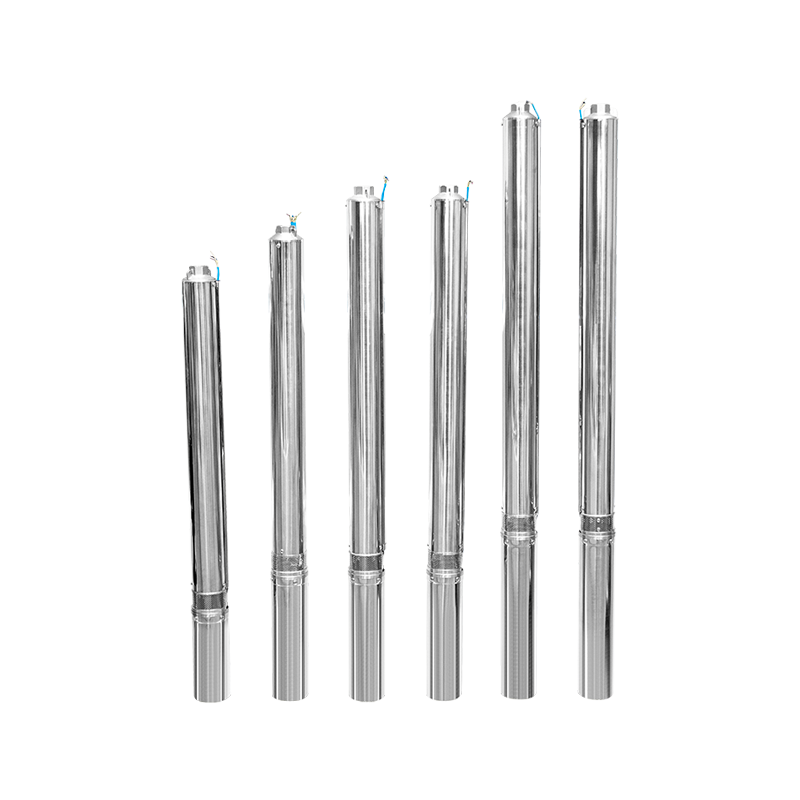
In practical terms, deep well pumps are engineered for installations starting at 30 meters and extending to 300 meters or more in high-capacity configurations. The slim, elongated body profile — necessary to fit inside the well casing — combined with a sealed submersible motor and multiple pressure-building stages defines the category. These structural characteristics are not stylistic choices; they are engineering responses to the specific demands of extracting water from significant depth. Zehao's deep well pump series for groundwater extraction is built around this push-from-below principle, with stainless steel construction and multi-stage hydraulic design optimized for reliable operation across a wide depth range.
Content
How a Deep Well Pump Works: The Multistage Centrifugal Principle
Understanding the operating mechanism helps explain both why multistage centrifugal pumps dominate deep well applications and what distinguishes a high-performance pump from a marginal one.
The process begins with the submersible motor. Housed in a sealed, water-filled casing that uses the surrounding groundwater for cooling, the motor drives a central shaft connected to a stack of impellers arranged in series. When the motor runs, each impeller spins at high speed, accelerating water outward through centrifugal force. As water exits each impeller stage, it enters a diffuser that converts kinetic energy into static pressure. The water then enters the next impeller stage, where the process repeats.
Each stage adds a fixed increment of pressure to the water column above it. A single-stage pump can deliver moderate head; a pump with eight, ten, or twelve stages accumulates those increments into the high total dynamic head needed to lift water from 100 or 200 meters below the surface. This is why deep well pump selection almost always involves specifying both the number of stages and the impeller diameter — together, these determine the pump's operating curve and its suitability for a given combination of depth and flow rate.
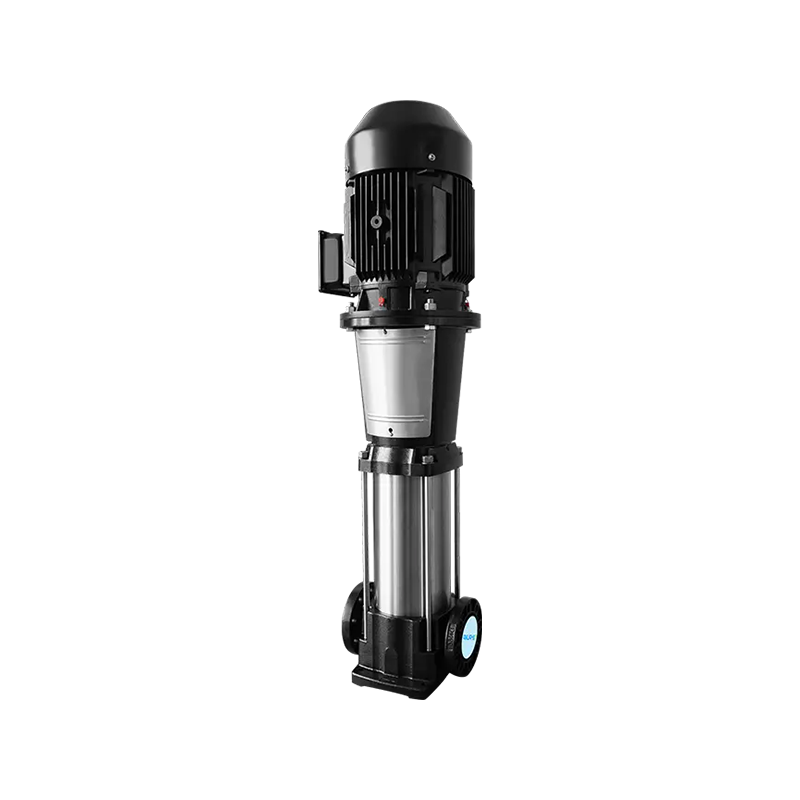
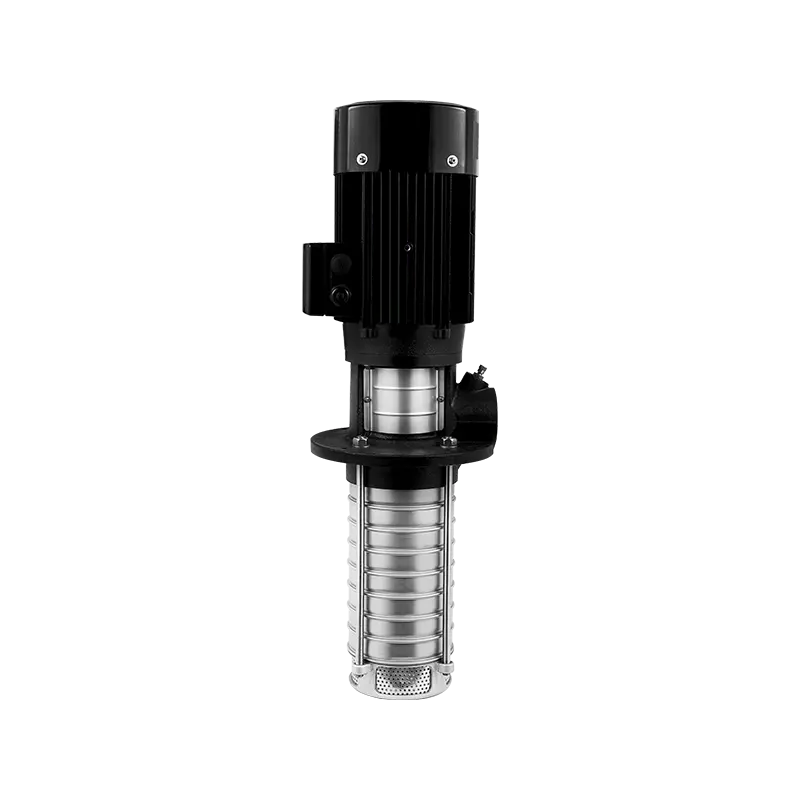
The sealed wet motor design is equally important. Unlike surface-mounted motors that require external cooling systems, the submersible motor is cooled passively by the groundwater flowing past its casing during operation. This design eliminates overheating as a failure mode in normal operating conditions and removes the mechanical complexity of long drive shafts that older turbine pump configurations required. Zehao's immersed multistage centrifugal pumps for high-pressure applications apply the same staged centrifugal principle in configurations suited to both deep well and high-pressure process applications.
Common Types of Deep Well Pumps
The deep well pump category includes several distinct configurations, each optimized for different depth ranges, power sources, and operational contexts. Selecting the right type is as important as selecting the right size.
Submersible Deep Well Pump
The submersible pump is the most widely deployed configuration for wells deeper than 50 meters. The entire assembly — motor, impeller stack, and inlet screen — is installed inside the well casing, submerged below the water level. Because there are no moving components at the surface and no long drive shaft to align and maintain, submersible pumps are mechanically simpler in installation and quieter in operation than surface-mounted alternatives. They are the standard choice for residential water supply, agricultural irrigation systems, and industrial groundwater extraction where reliability over a long service interval is the primary requirement.
Deep Well Turbine Pump
The turbine pump positions the motor above ground, connected to the impeller assembly below via a long vertical drive shaft that runs inside the well casing. This configuration was historically common in municipal and agricultural applications where large flow rates were required and motor accessibility for maintenance was a priority. Turbine pumps can handle very high flow rates and are adaptable to variable speed drives, but the drive shaft introduces alignment and bearing maintenance requirements that submersible configurations avoid.
Deep Well Jet Pump
Jet pumps use the venturi effect to assist water extraction, with the motor and ejector assembly installed at the surface and a jet nozzle lowered into the well. They are practical for mid-depth wells in the 25 to 50 meter range and are easier to service than fully submersible systems. However, their efficiency decreases significantly as depth increases, and they are not suitable for wells deeper than approximately 50 to 60 meters under typical operating conditions.
Solar-Powered Deep Well Pump
Solar deep well pumps use photovoltaic panels to power a DC submersible motor, typically through an MPPT (Maximum Power Point Tracking) controller that optimizes energy extraction from the panels across varying light conditions. This configuration eliminates grid electricity dependency entirely, making it viable for remote agricultural fields, off-grid communities, and disaster relief water supply installations. Modern solar pump systems with brushless DC motors and water-filled motor designs have demonstrated operating lifespans comparable to grid-powered equivalents.
| Type | Typical Depth Range | Best Application | Key Consideration |
|---|---|---|---|
| Submersible Deep Well Pump | 50–300 m | Residential, agriculture, industry | Requires well casing ID ≥ pump OD; motor not field-accessible |
| Deep Well Turbine Pump | 30–300 m | Municipal, large-scale agriculture | Drive shaft alignment and bearing maintenance required |
| Deep Well Jet Pump | 25–60 m | Mid-depth residential wells | Efficiency drops sharply beyond 50 m |
| Solar Deep Well Pump | 30–150 m | Off-grid, remote, agricultural | Flow rate varies with solar irradiance; MPPT controller required |
Key Applications Across Industries
Deep well pumps support water extraction across a wider range of end uses than their name suggests. The common thread is the need to access groundwater reliably at depth — but the performance requirements, flow rates, and operational duty cycles differ significantly between sectors.
Agricultural Irrigation
Agriculture accounts for the largest share of deep well pump installations globally, and the demand logic is straightforward: surface water sources are seasonal and increasingly unreliable in regions experiencing prolonged dry periods, while groundwater aquifers provide a stable year-round supply. Deep well submersible pumps feeding drip irrigation systems, sprinkler networks, and gravity distribution channels are now standard infrastructure on farms of all scales. For irrigation applications, flow rate and operating efficiency across a duty cycle that may span eight to twelve hours per day are the dominant selection criteria.
Residential and Rural Water Supply
Homes and communities not connected to municipal water infrastructure rely entirely on deep well systems for drinking water, sanitation, and domestic use. In these applications, pressure consistency matters as much as raw flow rate — the pump typically feeds a pressure tank that maintains system pressure between pump cycles, allowing the pump to run intermittently rather than continuously. Stainless steel construction is strongly preferred in potable water applications because it eliminates any risk of metallic contamination and maintains flow passage integrity across long service intervals without corrosion-driven degradation.
Industrial and Mining Operations
Industrial facilities — including processing plants, cooling systems, construction sites, and mining operations — require large volumes of water on a continuous basis. Deep well pumps in industrial service face more demanding conditions than residential equivalents: higher flow rates, longer duty cycles, greater sand and particulate content in some aquifers, and the need for consistent output pressure to support downstream process equipment. For mining dewatering specifically, pump reliability under continuous operation is critical, as pump failure in an active mine can halt production entirely. Zehao's sewage pump series for industrial and municipal wastewater addresses the parallel requirement for handling process water and wastewater alongside clean water extraction in industrial environments.
Municipal and Urban Water Supply
Municipal water utilities in regions where surface water is insufficient — or where groundwater provides a supplementary supply to buffer peak demand — operate deep well pump stations as core infrastructure. Municipal applications typically specify high-capacity turbine or multistage submersible pumps with variable frequency drives (VFDs) to allow flow modulation in response to demand. Energy efficiency at scale is a significant procurement criterion: a one percentage point improvement in pump efficiency across a municipal well field that runs around the clock translates to material annual savings in operating cost.
How to Select the Right Deep Well Pump
Pump selection errors are expensive in deep well applications because retrieval, replacement, and re-installation involve significant labour and downtime. Getting the specification right before purchase is always less costly than correcting a mismatch after installation.
Well Depth and Total Dynamic Head
Total dynamic head (TDH) is the pump's primary sizing parameter. It equals the static water lift (distance from the pump to the discharge point) plus friction losses in the piping system plus any residual pressure required at the point of use. TDH, not well depth alone, determines the pump head rating you need. A well that is 80 meters deep but discharges into a pressurized system may require a pump rated for 120 or more meters of TDH once friction and system pressure are factored in.
Required Flow Rate
Flow rate (expressed in cubic meters per hour or gallons per minute) must match the actual water demand of the application. Under-sizing leads to insufficient supply during peak demand; over-sizing forces the pump to operate far from its best efficiency point, increasing energy consumption and accelerating wear. For irrigation systems, calculate peak-hour demand across the irrigated area. For industrial applications, confirm the process flow requirement plus any system losses or storage buffer requirements.
Power Source and Motor Type
Grid-connected applications typically use standard AC induction motors paired with single or three-phase supply, depending on power availability and motor size. Off-grid installations require DC brushless motors compatible with solar panels and MPPT controllers. Variable frequency drive (VFD) compatibility is worth specifying for applications where flow modulation under variable demand is operationally valuable — both for energy saving and to reduce pump start-stop cycling stress.
Water Quality and Sand Content
Groundwater is rarely pure. Sand and fine particulates in the water column are among the leading causes of premature pump failure in deep well applications, as abrasive particles erode impeller surfaces and wear clearances over time. Pumps intended for sandy aquifers should specify impellers and diffusers in abrasion-resistant materials and confirm the maximum sand content rating in milligrams per liter. Water with high mineral content, salinity, or chemical loading requires corrosion-resistant materials throughout the pump assembly — stainless steel grade selection (304 vs 316) matters in these environments.
Pump Diameter and Well Casing Compatibility
The pump's outer diameter must fit inside the well casing with adequate clearance for installation, retrieval, and water flow past the motor for cooling. Standard well casings range from 3 inches for residential boreholes to 10 inches or more for high-capacity municipal wells. Always confirm the pump's nominal outside diameter against the well casing inside diameter before ordering, including allowance for any centralizers or cable guards used during installation.
Material Selection: The Case for Stainless Steel
Stainless steel construction — for the pump casing, impellers, diffusers, and motor shell — is the most significant quality differentiator in deep well pump procurement. Cast iron and engineering plastics are cost-competitive at purchase but degrade faster in corrosive groundwater environments, require more frequent replacement, and introduce contamination risk in potable water applications. Stainless steel's resistance to electrochemical corrosion, its mechanical strength under continuous hydraulic stress, and its suitability for food-grade and potable water certification make it the rational long-term choice for any installation expected to operate for eight to fifteen years with minimal intervention.

Recommended Products
It is focused on the overall solution of dry bulk material port transfer system,
research and development, manufacturing, and service

 English
-
 Factory Area 5-6, No. 1118 Xin'an Road, Nanxun Town, Huzhou City, Zhejiang Province
-
 +86-4008117388
-
 [email protected]
Copyright © Zhejiang Zehao Pump Industry Co., Ltd. All Rights Reserved. Stainless Steel Multistage Centrifugal Pumps Manufacturers

