


 English
 中文简体
中文简体 русский
Horizontal End Suction Centrifugal Pumps: Selection & Applications
Content
- 1 How Horizontal End Suction Centrifugal Pumps Work
- 2 Corrosion Resistant Pump Design: Materials That Extend Service Life
- 3 Industrial Applications: From Petrochemicals to Power Generation
- 4 Agricultural Irrigation Pump: Why the End-Suction Format Dominates Field Applications
- 5 Selection Criteria: Choosing the Right Horizontal End Suction Pump for Your Application
How Horizontal End Suction Centrifugal Pumps Work
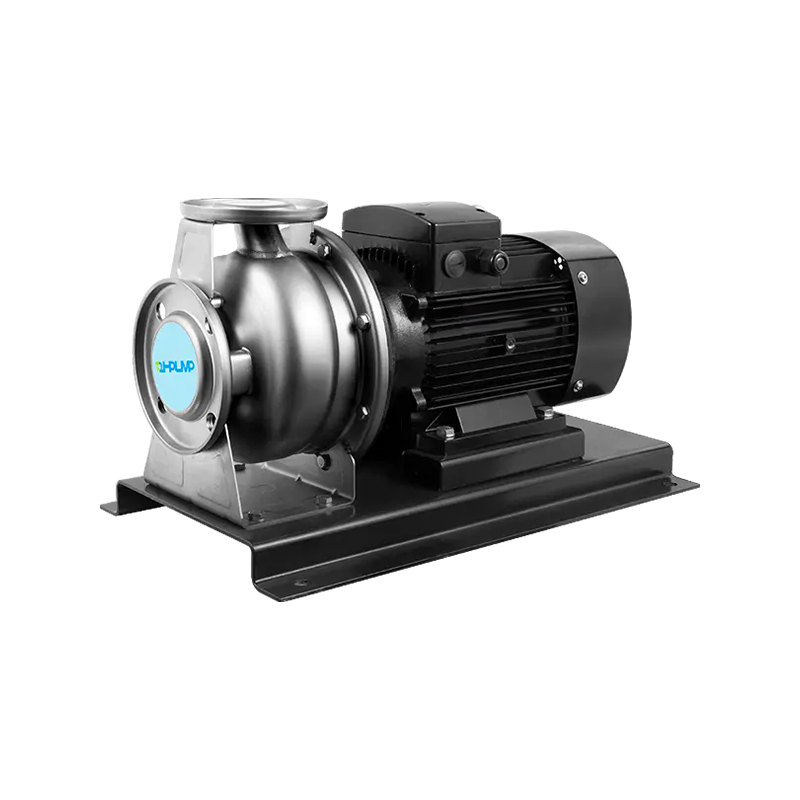
A horizontal end suction centrifugal pump operates on a straightforward but highly effective mechanical principle. The suction port and discharge port are both located on the same end of the pump body, which is mounted in a horizontal position with the shaft oriented parallel to the ground. When the motor drives the impeller to rotate at high speed, centrifugal force acts on the fluid within the impeller channels, accelerating it radially outward from the eye of the impeller toward the volute casing. This outward acceleration creates a low-pressure zone at the suction inlet, drawing fluid continuously into the pump body, while the high-pressure region at the discharge outlet pushes the medium into the downstream piping system.
The volute casing surrounding the impeller plays a critical role in converting the kinetic energy of the accelerated fluid into useful pressure energy. As the fluid decelerates through the expanding cross-section of the volute, velocity drops and static pressure rises, delivering a stable and consistent outlet pressure regardless of minor fluctuations in inlet conditions. This pressure stability is one of the defining performance characteristics of horizontal end suction centrifugal pumps, making them the preferred format for process applications where consistent flow and head are required over extended operating periods.
The single-stage end-suction configuration — one impeller, one volute, one set of shaft bearings — results in a mechanically simple assembly with fewer components than multi-stage or split-case alternatives. This simplicity directly reduces the number of potential failure points, eases routine inspection, and shortens repair times when maintenance is required. For facility engineers managing large fleets of pumps across industrial plants or irrigation networks, this maintainability advantage compounds over time into a measurable reduction in lifecycle operating cost.
Corrosion Resistant Pump Design: Materials That Extend Service Life
The ability to handle chemically aggressive, saline, or contaminated media without accelerated material degradation is one of the most commercially important attributes of a corrosion resistant pump. In horizontal end suction centrifugal pumps, corrosion resistance is not achieved through a single material choice but through a coordinated selection of wetted-part materials matched to the specific chemical properties of the fluid being handled. A pump specified correctly for its media will maintain dimensional integrity, seal performance, and hydraulic efficiency for years; one mismatched to its fluid can fail within months through pitting, crevice corrosion, or stress corrosion cracking.
Common Material Options for Corrosive Media
The primary material families used in corrosion resistant horizontal end suction centrifugal pumps are:
- Cast iron (GG25): The standard material for clean water and mildly corrosive media. Suitable for municipal water supply, drainage, and agricultural irrigation pump applications where the fluid pH is near neutral and chloride concentrations are low.
- 316L stainless steel: The workhorse alloy for chemical and food-grade applications. Offers strong resistance to chloride pitting at moderate concentrations and handles dilute acids, caustic solutions, and process chemicals encountered in petrochemical and pharmaceutical settings.
- Duplex stainless steel (2205): Selected for high-chloride environments such as seawater desalination, marine applications, and chlorinated process streams where 316L would suffer pitting attack. Duplex alloys offer roughly twice the yield strength of austenitic grades, enabling thinner wall sections without sacrificing pressure ratings.
- High-silicon cast iron: Used in concentrated sulfuric acid service where most stainless alloys are unsuitable. The high silicon content forms a protective silicate film that resists acid attack across a wide concentration range.
- PTFE-lined or glass-fiber-reinforced polymer (FRP): Applied in highly aggressive acid or solvent service where metallic materials cannot provide adequate corrosion life. Non-metallic linings isolate the casing from the fluid while the outer structural shell maintains mechanical strength.
Shaft sealing is equally critical in corrosion resistant pump specification. Mechanical seals with silicon carbide or tungsten carbide faces resist abrasion and chemical attack better than traditional packing glands, and they eliminate the continuous leakage path that packing creates — an important consideration when handling toxic, hazardous, or environmentally regulated fluids. For aggressive media, double mechanical seals with a compatible barrier fluid provide an additional layer of containment protection.
Industrial Applications: From Petrochemicals to Power Generation
Horizontal end suction centrifugal pumps serve as the primary fluid-moving workhorses across the full range of process industries. Their combination of stable pressure output, chemical compatibility, and straightforward maintenance makes them the default specification for liquid transfer and circulation duties in plants where uptime is a financial imperative.
| Industry | Typical Fluid | Key Pump Requirement | Recommended Material |
|---|---|---|---|
| Petrochemicals | Crude oil, solvents, caustics | Corrosion resistance, fire safety | 316L SS / Duplex SS |
| Papermaking | Pulp slurry, bleaching chemicals | Abrasion and chemical resistance | 316L SS / Hard alloy |
| Power generation | Cooling water, condensate | Continuous duty, high reliability | Cast iron / Carbon steel |
| Wastewater treatment | Sewage, sludge, effluent | Solids handling, corrosion resistance | Cast iron / 316L SS |
| Municipal water supply | Potable water, chlorinated water | NSF compliance, long service life | Cast iron / 304 SS |
In petrochemical plants, horizontal end suction pumps operate under API 610 (ISO 13709) standards, which specify enhanced design requirements for bearing life, shaft deflection limits, and mechanical seal arrangements. Compliance with this standard ensures that pumps used in hydrocarbon service meet the reliability and safety expectations of refinery and chemical plant operators, where unplanned shutdowns carry significant financial and safety consequences.
Agricultural Irrigation Pump: Why the End-Suction Format Dominates Field Applications
In agricultural contexts, the horizontal end suction centrifugal pump is the dominant pump format for irrigation systems ranging from small individual farm installations to large-scale canal distribution networks. The format's practical advantages align precisely with the operational realities of agricultural fluid management: seasonal deployment and retrieval, variable flow demands tied to crop and weather cycles, and the need for non-specialist operators to install, adjust, and maintain equipment in the field without access to sophisticated tools or technical support.
An agricultural irrigation pump based on the end-suction centrifugal design handles not just clean water but the range of water qualities encountered in farming environments — water drawn from rivers, canals, reservoirs, and wells may carry silt, organic debris, and dissolved minerals that would challenge less robust designs. Cast iron impellers with hardened wear rings resist the abrasive action of suspended solids; oversized shaft bearings accommodate the radial loads generated when operating away from the best efficiency point during partial-throttle irrigation cycles; and replaceable wear rings allow hydraulic performance to be restored after extended service without replacing the entire pump assembly.
The corrosion resistant pump characteristic becomes particularly relevant in agricultural irrigation when chemical fertilizers or pesticides are injected directly into the irrigation stream — a practice known as fertigation. In fertigation systems, the pump and its wetted components are continuously exposed to concentrated fertilizer solutions that can be mildly acidic or contain ammonium compounds aggressive to standard cast iron. Stainless steel impellers and casings, or cast iron with appropriate epoxy coatings, extend service life significantly in these applications and eliminate contamination risk from corroded metal surfaces entering the water supply used on food crops.
From an energy standpoint, correctly sized agricultural irrigation pumps operating near their best efficiency point (BEP) consume significantly less power per unit of water delivered than oversized pumps throttled back by partial valve closure. Given that irrigation pumping can account for 30–50% of a farm's total energy expenditure, the efficiency impact of pump selection is a direct line item on the operating budget. Horizontal end suction centrifugal pumps matched to the system's actual flow and head requirements — rather than selected by rule-of-thumb oversizing — deliver both performance and running cost advantages that accumulate meaningfully across a full irrigation season.
Selection Criteria: Choosing the Right Horizontal End Suction Pump for Your Application
Selecting a horizontal end suction centrifugal pump that will perform reliably over its full service life requires working through a structured set of application parameters. Purchasing on price alone without confirming hydraulic fit, material compatibility, and mechanical adequacy is the most common cause of premature pump failure across both industrial and agricultural installations.
Hydraulic Parameters: Flow Rate and Head
The operating point — the intersection of the pump's performance curve with the system resistance curve — must fall within the pump's allowable operating range, ideally between 80% and 110% of the best efficiency point flow rate. Operating significantly left of BEP (low flow, high head) causes internal recirculation, radial thrust increases, and accelerated bearing and seal wear. Operating far right of BEP (high flow, low head) risks cavitation, which erodes impeller surfaces and generates vibration and noise. Confirming the system's actual flow and head requirements through pipe network calculations before pump selection is a non-negotiable step for reliable long-term operation.
Fluid Properties and Material Specification
Beyond flow and head, the chemical and physical properties of the fluid determine material selection for all wetted components. Key fluid parameters to document before specifying a corrosion resistant pump include: pH range, chloride concentration, temperature range, presence of abrasive solids (particle size and concentration), viscosity if above water-equivalent, and any regulatory requirements for materials in contact with potable water or food-contact media. A pump supplier provided with complete fluid characterization data can recommend the optimum material package with confidence; one provided only with generic descriptions such as "chemical fluid" or "process water" is forced to over-specify conservatively or risk an undersized corrosion allowance.
For buyers sourcing horizontal end suction centrifugal pumps for multi-site deployment — whether equipping a network of agricultural irrigation stations or standardizing pump specifications across multiple process plants — establishing a clear specification template covering hydraulic duty, fluid characterization, material requirements, seal type, and driver details eliminates ambiguity in the procurement process and ensures that delivered equipment meets operational requirements consistently across the entire installation fleet.

Recommended Products
It is focused on the overall solution of dry bulk material port transfer system,
research and development, manufacturing, and service

 English
-
 Factory Area 5-6, No. 1118 Xin'an Road, Nanxun Town, Huzhou City, Zhejiang Province
-
 +86-4008117388
-
 [email protected]
Copyright © Zhejiang Zehao Pump Industry Co., Ltd. All Rights Reserved. Stainless Steel Multistage Centrifugal Pumps Manufacturers

