


 English
 中文简体
中文简体 русский
Industry News
Home / News / Industry News / Horizontal Multistage Pump: How It Works, Applications & Selection Guide

Pressure doesn't build itself. Moving water to the top floor of a high-rise, feeding a boiler at precise operating pressure, or irrigating a large farm across uneven terrain—these tasks demand pumps that can develop significantly more head than a single impeller can provide. That's exactly the problem a horizontal multistage pump is engineered to solve.
This guide breaks down how these pumps work, where they perform best, how to select the right configuration, and what it takes to keep one running reliably for years.
Content
The operating principle starts with centrifugal force. Inside the pump casing, a motor drives a shaft that spins multiple impellers at high speed. Each impeller accelerates the liquid outward from its center, converting rotational energy into velocity. That velocity is then directed through guide vanes, which slow the flow and convert kinetic energy into pressure.
What sets a multistage design apart is the series arrangement: the pressurized discharge from one impeller feeds directly into the inlet of the next. Each stage adds another increment of pressure, and the stages stack until the total head at the outlet meets the application requirement. A pump with five stages, for example, can develop roughly five times the pressure of a comparable single-stage unit running at the same speed.
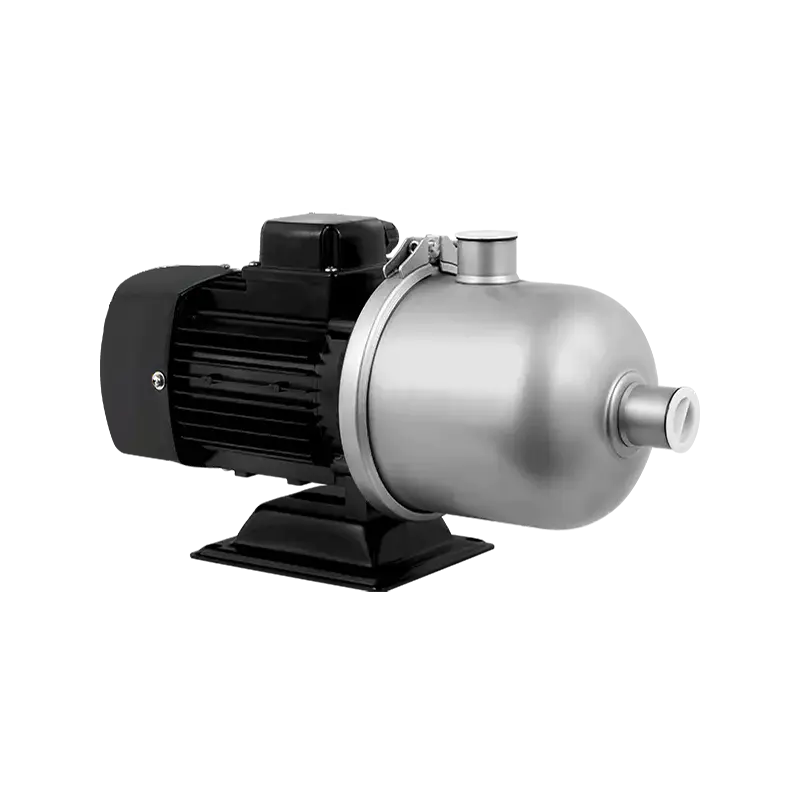
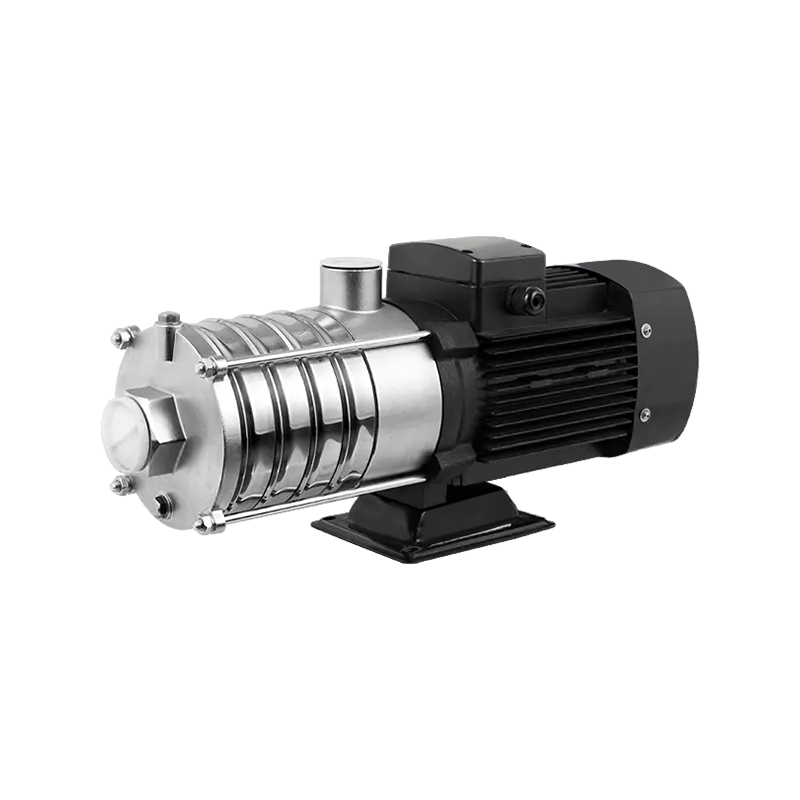
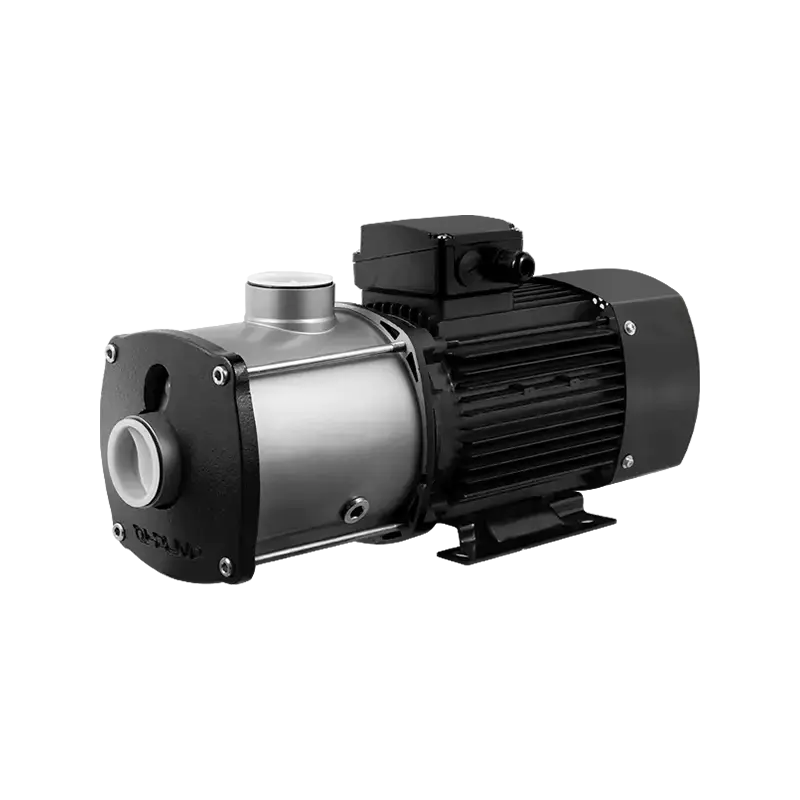
In a horizontal configuration, the shaft runs parallel to the ground. All impellers share the same shaft, aligned end to end within a segmented casing. The liquid enters from one end, travels through each stage in sequence, and exits at high pressure from the opposite end. Bearings at both ends of the shaft maintain alignment under the axial and radial forces generated during operation. Our ZHH horizontal multistage centrifugal pump is a practical example of this architecture, designed for stable, high-head water supply in building and industrial settings.
The most immediate advantage is the ability to reach high head values without relying on an oversized single impeller. Large single-stage impellers spinning at high speeds introduce mechanical stress, vibration, and efficiency losses that become difficult to manage. The multistage approach distributes the pressure-building work across several smaller stages, each operating at a more manageable load point.
Flow stability is another benefit. Because each stage conditions the fluid before passing it to the next, pressure fluctuations are smoothed out progressively. The result is a steady, consistent outlet pressure—essential for processes like boiler feed, where unstable supply pressure can affect system performance directly.
Energy efficiency also deserves attention. Multistage pumps can achieve the same total head as a larger single-stage pump while consuming less power, because the work is divided into smaller, more efficient increments. The EU Ecodesign Regulation for water pumps (EU Regulation No. 547/2012) sets minimum hydraulic efficiency requirements at the best efficiency point, part load, and overload conditions—a standard that modern horizontal multistage designs are engineered to meet and exceed.
Space efficiency is an often-overlooked strength. Despite handling high-pressure duties, horizontal multistage pumps have a relatively compact footprint compared to alternative configurations needed for the same head. Their horizontal shaft orientation also makes them straightforward to inspect, align, and service without specialized lifting equipment. Explore the full horizontal pump series to see the range of configurations available for different pressure and flow requirements.
Horizontal multistage pumps appear across a wide range of industries, united by one common requirement: consistent delivery of liquid at elevated pressure.
Urban and building water supply. Municipal waterworks use these pumps to lift water from treatment facilities and maintain pressure across distribution networks. In high-rise buildings, they serve as booster pumps, ensuring adequate flow pressure reaches upper floors where system pressure would otherwise fall short.
Industrial process systems. In petrochemical plants, multistage pumps transport raw materials and process fluids at the pressures required for refining operations. Power generation facilities rely on them as boiler feed pumps, delivering high-pressure feedwater to steam generators within precise tolerance. Metallurgical plants use them to circulate cooling water through furnaces and rolling equipment.
Fire protection systems. As dedicated fire pumps, horizontal multistage units provide the pressure and flow needed to propel water through sprinkler networks and hose stations. Their ability to develop high pressure rapidly and maintain it under sustained demand makes them well-suited to this critical safety role.
Agricultural irrigation. On large farms with significant elevation differences between water sources and irrigated fields—or where fields are spread over long distances—horizontal multistage pumps deliver the head necessary to move water reliably to every zone of the irrigation network.
Selecting the wrong pump is far more expensive than taking the time to specify correctly. Four parameters dominate the selection process.
Flow rate (Q). Determine the peak volume of liquid the system needs to move, expressed in m³/h or L/s. Size the pump for actual operating demand, not theoretical maximum—oversizing leads to throttling, efficiency losses, and accelerated wear.
Total head (H). Calculate the total head the pump must overcome: static head (elevation difference), friction losses through piping, and any back-pressure in the system. This figure determines how many stages the pump requires. More stages deliver more head; fewer stages mean a more compact, lower-cost unit where the application allows it.
Liquid properties. Clean, cold water is the baseline. Applications involving slightly elevated temperatures, minor chemical content, or trace solids require attention to material selection. Stainless steel flow components—standard in many modern designs—provide a practical level of corrosion resistance for light-duty chemical service. For anything more aggressive, verify material compatibility specifically.
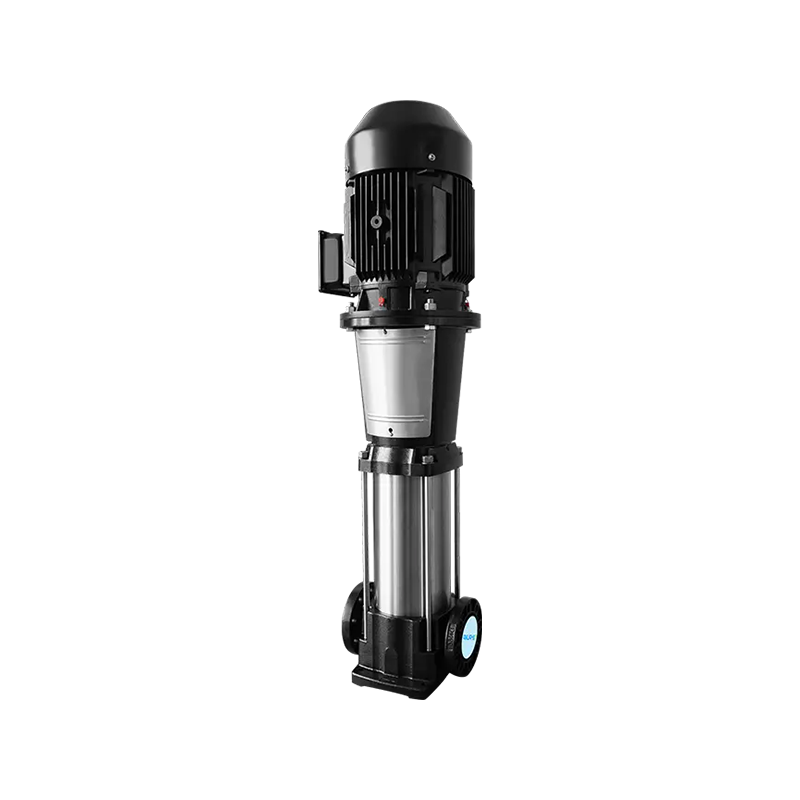
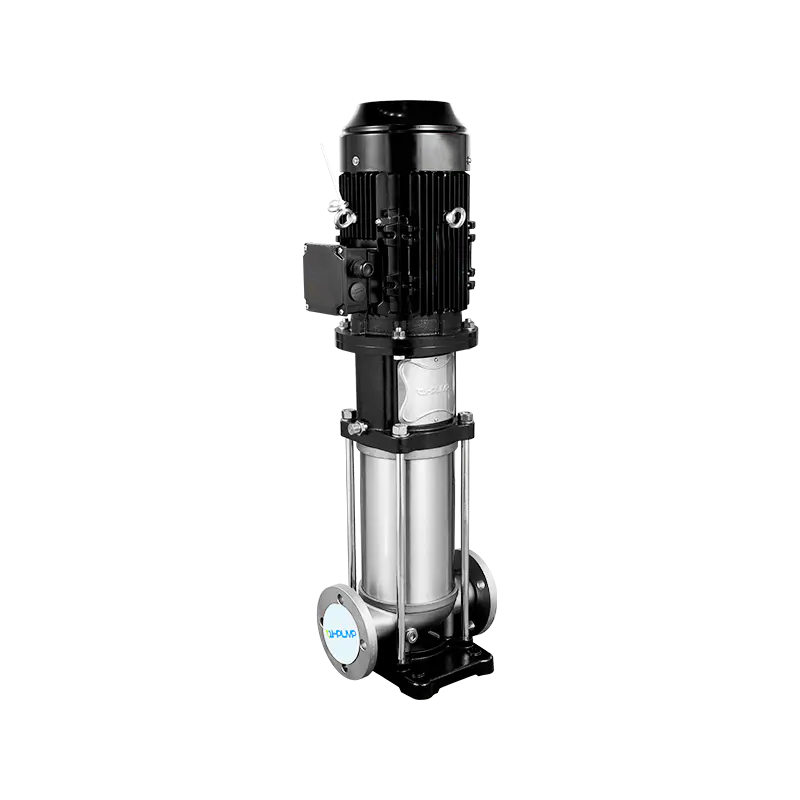
Stage count and model configuration. Once flow and head requirements are confirmed, match them to available pump curves. The ZHF/ZHFF segmental horizontal multistage centrifugal pump is designed for higher-head applications where a segmented casing allows the stage count to be configured to match specific system demands. For installations where space and energy efficiency are the primary constraints, the ZHM new horizontal multistage centrifugal pump offers an updated hydraulic design optimized for those priorities. When floor space is genuinely limited and a vertical orientation is viable, high-efficiency vertical multistage pump options may be worth evaluating alongside the horizontal models.
A well-maintained horizontal multistage pump routinely operates for years without major intervention. The key is catching small issues before they become expensive failures.
Monitor operating parameters regularly. Track discharge pressure, flow rate, motor current draw, and bearing temperature during normal operation. Any sustained deviation from baseline values is a signal that something has changed—whether it's a developing seal leak, increased system resistance, or early-stage impeller wear.
Inspect mechanical seals on schedule. Mechanical seals are the most common wear point in horizontal multistage pumps. Many modern designs use maintenance-free sealed configurations, but even these have a finite service life. Check for any signs of leakage at the seal face and replace seal assemblies at the intervals specified by the manufacturer rather than waiting for a failure.
Keep bearings lubricated and clean. Bearings support the shaft against both axial thrust and radial loads. Follow the manufacturer's lubrication schedule precisely—under-lubrication causes overheating and fatigue failure, while over-lubrication can attract contaminants and generate excess heat. If the pump uses grease-lubricated bearings, purge old grease before repacking.
Check shaft alignment after any piping work. Horizontal pumps are sensitive to pipe strain. If connecting pipework is modified, reconnected, or disturbed during maintenance, realign the pump-to-motor coupling before restarting. Misalignment causes vibration, shortens bearing life, and can damage the mechanical seal.
Act on vibration and noise changes promptly. Unusual vibration or noise—especially at startup or under load—often indicates cavitation, impeller damage, or bearing wear. Cavitation, in particular, causes rapid internal erosion and can destroy impellers within hours of continuous operation. If the pump is cavitating, address the root cause (insufficient inlet pressure, excessively high flow demand, or system air ingress) rather than simply continuing to run it.
It is focused on the overall solution of dry bulk material port transfer system,
research and development, manufacturing, and service
 Factory Area 5-6, No. 1118 Xin'an Road, Nanxun Town, Huzhou City, Zhejiang Province
 +86-4008117388
 [email protected]
Copyright © Zhejiang Zehao Pump Industry Co., Ltd. All Rights Reserved. Stainless Steel Multistage Centrifugal Pumps Manufacturers





 English