


 English
 中文简体
中文简体 русский
Horizontal Centrifugal Pump: Design, Applications & Selection Guide
Across water treatment plants, high-rise building systems, and petrochemical pipelines, one pump type consistently appears at the center of fluid transfer decisions: the horizontal centrifugal pump. Its dominance is not accidental. The combination of reliable operation, straightforward maintenance, and adaptability to a wide range of media has made it the default choice for engineers specifying fluid handling equipment worldwide.
This article examines what drives that preference—and what buyers and engineers need to understand before selecting one.
Content
- 1 Why Horizontal Centrifugal Pumps Dominate Industrial Fluid Transfer
- 2 How the Design Drives Performance
- 3 Seal Material Selection: Matching the Pump to Your Medium
- 4
- 5 Key Applications Across Industries
- 6 Horizontal vs. Vertical: Choosing the Right Orientation
- 7 What to Look for When Selecting a Horizontal Centrifugal Pump
Why Horizontal Centrifugal Pumps Dominate Industrial Fluid Transfer
The horizontal centrifugal pump operates on a principle that is deceptively simple: a motor-driven impeller spins at high speed, generating centrifugal force that pushes fluid outward through the pump casing and into the discharge pipe. The result is a continuous, stable flow with minimal mechanical complexity.
That simplicity is a feature, not a limitation. Fewer moving parts means fewer failure points. The horizontal shaft orientation keeps the impeller and motor aligned on the same plane, making visual inspection, alignment checks, and routine servicing straightforward—without specialized tools or confined-space procedures.
Where other pump types require significant downtime for maintenance access, a horizontal centrifugal pump can often be serviced in place. For operations where uptime directly affects output, that matters.
How the Design Drives Performance
Performance in a centrifugal pump is a function of impeller geometry, casing design, and the mechanical integrity of the shaft assembly. In horizontal configurations, the shaft is supported between two bearing housings, distributing axial and radial loads more evenly than overhung designs. This arrangement reduces vibration, lowers noise levels, and extends bearing service life under continuous operation.
One structural advantage that is often overlooked: horizontal multistage centrifugal pumps can achieve a notably shorter axial length compared to traditional single-suction designs. The compact footprint improves installation flexibility and contributes to lower vibration amplitudes during high-speed operation—a meaningful benefit in noise-sensitive environments or installations with strict structural constraints.
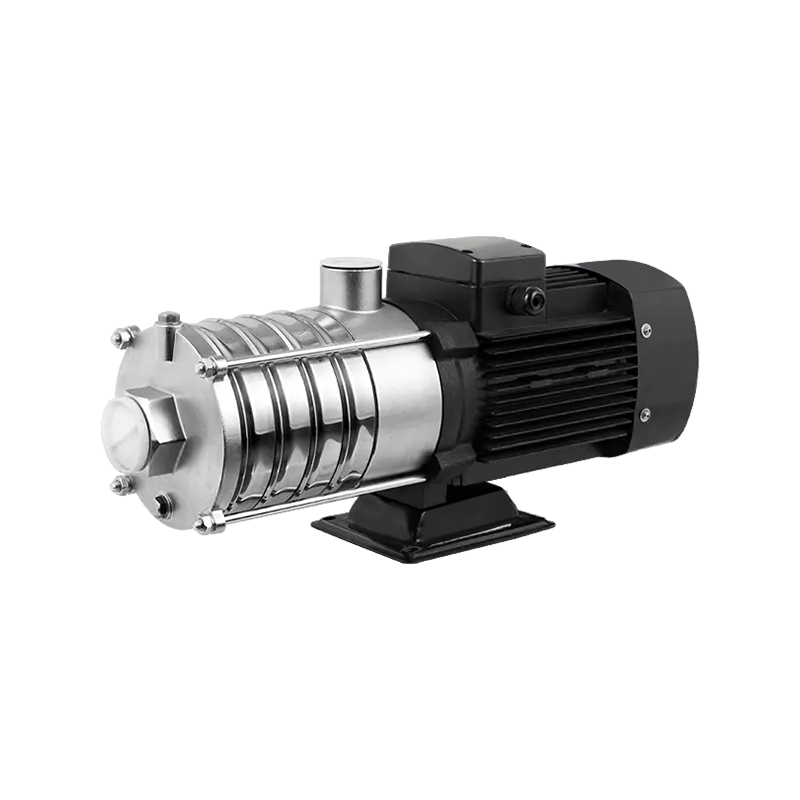
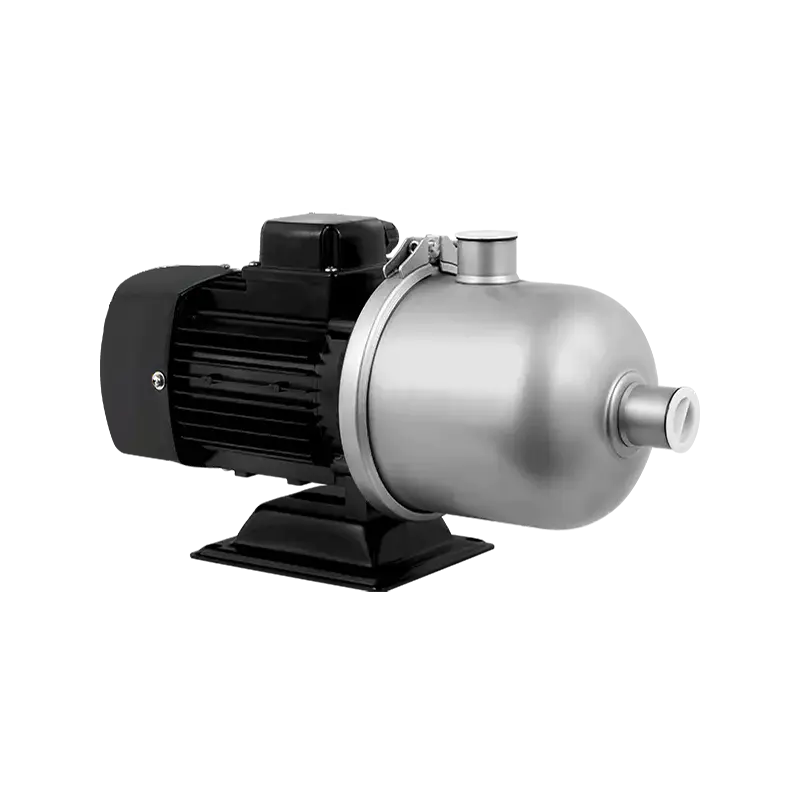
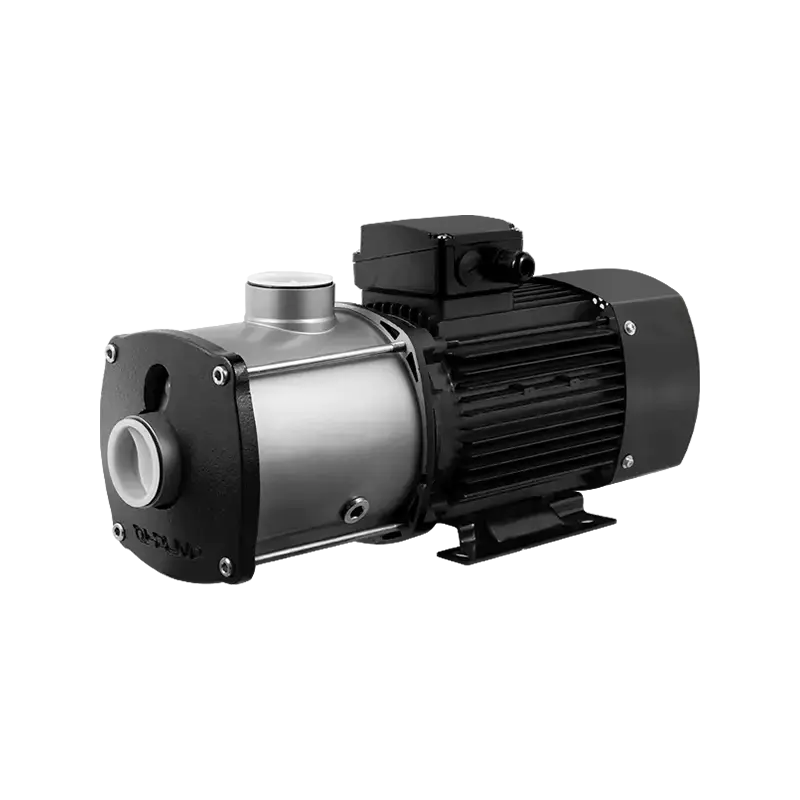
For applications requiring higher head, multiple impeller stages can be added within the same horizontal casing. Each stage incrementally boosts pressure, allowing the pump to reach operating pressures that a single-stage design cannot achieve. Explore the horizontal multistage centrifugal pump built for high-pressure fluid transfer and the segmental horizontal multistage pump with modular stage configuration for demanding industrial duties.
Seal Material Selection: Matching the Pump to Your Medium
The seal is one of the most consequential choices in horizontal centrifugal pump specification. A mismatched seal leads to leakage, contamination, accelerated wear, or premature failure—none of which are acceptable in process environments.
For clean water and general industrial service, standard mechanical seals with carbon-ceramic faces provide reliable, cost-effective performance. For chemically aggressive or abrasive media, hard alloy seals—typically tungsten carbide or silicon carbide—offer significantly better resistance to wear and chemical attack. These materials maintain face integrity under conditions that would rapidly degrade softer seal components.
The selection logic is straightforward: match the seal face material to the corrosivity and particle content of the fluid. Operators handling dilute acids, alkalis, or slurries should specify corrosion-resistant alloy seals from the outset rather than retrofitting after early failure.
| Seal Type | Recommended Media | Key Advantage |
|---|---|---|
| Carbon-Ceramic Mechanical Seal | Clean water, non-corrosive liquids | Cost-effective, widely available |
| Tungsten Carbide Seal | Abrasive media, light slurries | High wear resistance |
| Silicon Carbide Seal | Corrosive chemicals, hot fluids | Chemical and thermal resistance |
| PTFE-lined Seal | Aggressive acids and alkalis | Broad chemical compatibility |
Key Applications Across Industries
Municipal water supply and building services. Horizontal centrifugal pumps are the backbone of urban water distribution networks and high-rise building pressurization systems. Their ability to maintain stable pressure across varying demand loads makes them well-suited to systems where flow fluctuates throughout the day.
Petrochemical and process industries. In refineries and chemical plants, these pumps handle hydrocarbons, process water, and chemical intermediates. The availability of corrosion-resistant casing materials—cast iron, stainless steel, duplex alloys—means engineers can specify a pump matched to the exact chemical profile of the process stream.
Power generation. Boiler feed and cooling water circulation are critical pump duties in thermal and nuclear power stations. Horizontal multistage configurations are commonly used for boiler feed service, where high head and precise flow control are non-negotiable.
Agricultural irrigation. For large-scale irrigation schemes with long distribution distances or significant elevation changes, horizontal centrifugal pumps provide the flow rates and operating pressures needed to reach remote delivery points reliably.
HVAC and building mechanical systems. Chilled water circulation, condenser water loops, and heating systems all rely on centrifugal pumps for continuous, low-maintenance operation. Horizontal configurations are preferred in plant room installations where access for maintenance must be maintained alongside the equipment.
Horizontal vs. Vertical: Choosing the Right Orientation
Orientation choice comes down to three practical factors: available floor space, maintenance access, and operating temperature.
Horizontal pumps require more floor area but less headroom, and they offer a significant maintenance advantage—all serviceable components are accessible from ground level without lifting equipment. Bearing replacement, seal inspection, and impeller removal can be completed by two technicians working at bench height.
Vertical pumps occupy less floor space and are often specified in wet pit installations where the pump must be submerged or positioned close to the fluid source. However, bearing access typically requires partial disassembly from above, which adds time and complexity to scheduled maintenance.
Horizontal centrifugal pumps also perform better in high-temperature service, where thermal expansion of the shaft and casing needs to be managed with precision alignment—something the between-bearing horizontal configuration handles more predictably than most vertical designs. For single-stage general duties, the single-stage end-suction centrifugal pump for direct-coupled operation covers a broad range of standard industrial and building services applications.
What to Look for When Selecting a Horizontal Centrifugal Pump
Selection errors are more common than they should be—often because buyers focus on headline flow rate and head figures without examining the full operating envelope. Here are the critical parameters to verify before specifying:
- Duty point vs. pump curve. Confirm the required flow rate and head fall within the pump's best efficiency point (BEP) range. Operating significantly off-BEP accelerates wear and increases energy consumption.
- NPSH margin. The system's available Net Positive Suction Head (NPSHa) must exceed the pump's required NPSH (NPSHr) by a sufficient margin to prevent cavitation.
- Casing and impeller material. Match materials to the fluid's pH, temperature, and solids content. Stainless steel is appropriate for mildly corrosive media; higher-alloy materials are needed for aggressive chemical service.
- Seal specification. Define the seal type and face material based on the medium being pumped, not just the nominal operating conditions.
- Motor and drive selection. For variable-demand systems, a variable frequency drive (VFD) allows speed modulation that reduces energy consumption and extends component life compared to throttling valves.
- Stage count for multistage applications. If head requirements exceed what a single-stage pump can deliver economically, evaluate multistage options. The new-generation horizontal multistage pump with compact housing design addresses high-head requirements without the large footprint of older segmental designs.
For a full overview of available configurations, the complete horizontal pump series covers single-stage, multistage, and segmental models suited to a wide range of industrial and commercial duties.

Recommended Products
It is focused on the overall solution of dry bulk material port transfer system,
research and development, manufacturing, and service


 English
-
 Factory Area 5-6, No. 1118 Xin'an Road, Nanxun Town, Huzhou City, Zhejiang Province
-
 +86-4008117388
-
 [email protected]
Copyright © Zhejiang Zehao Pump Industry Co., Ltd. All Rights Reserved. Stainless Steel Multistage Centrifugal Pumps Manufacturers

