


 English
 中文简体
中文简体 русский
Vertical Multistage Pump: High Efficiency Guide & Applications
Content
What Is a Vertical Multistage Pump?
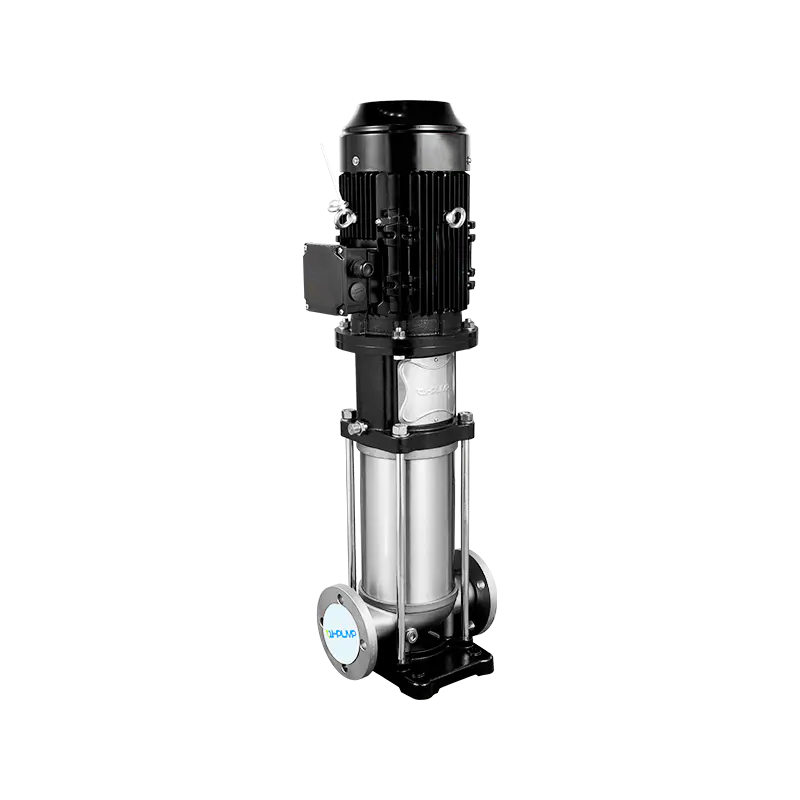
A vertical multistage pump is a centrifugal pump in which multiple impeller stages are stacked in series along a single vertical shaft, each stage adding pressure to the liquid as it passes through. Unlike a single-stage pump that generates pressure through one impeller rotation, a multistage configuration multiplies the pressure output by the number of stages — allowing the pump to achieve high discharge pressures from a compact, space-efficient vertical footprint. The liquid enters at the bottom stage, gains pressure at each successive impeller, and exits at the top of the pump body at significantly elevated pressure without requiring the large diameter impellers or high rotational speeds that would otherwise be needed in a single-stage design.
The vertical orientation is not incidental — it is fundamental to the design's advantages. A vertical shaft arrangement eliminates the need for a separate bearing housing at the wet end of the pump, allows the motor to sit directly above the pump body on the same centerline, and enables a narrow installation footprint that makes vertical multistage pumps particularly well-suited to plant rooms, booster stations, and installations where floor space is constrained. The vertical configuration also facilitates self-priming from flooded suction conditions and simplifies maintenance access to the motor and mechanical seal from above without disturbing the pipework connections.
How Multistage Pressurization Works
Understanding the staging principle clarifies both the performance capabilities and the application limits of vertical multistage pumps. In a centrifugal pump, pressure is generated by the transfer of kinetic energy from the rotating impeller to the liquid, which is then converted to static pressure in the diffuser surrounding the impeller. The maximum pressure a single stage can generate is governed by the impeller diameter and rotational speed — both of which have practical limits set by material strength, motor speed, and the velocity at which cavitation begins to occur at the impeller inlet.
By connecting stages in series — so that the discharge of one stage feeds directly into the inlet of the next — the pressure increments of each stage are additive. A pump with six stages each contributing 10 bar of pressure delivers 60 bar total discharge pressure, using the same impeller diameter and rotational speed that a single-stage pump would use to produce 10 bar. This is the essential efficiency insight of the multistage design: high pressure is achieved through hydraulic addition rather than through increases in impeller speed or diameter, keeping mechanical stresses, bearing loads, and shaft seal demands within manageable limits across the full pressure range.
The number of stages in commercially available vertical multistage pumps typically ranges from 2 to 20 or more, with total discharge pressures reaching 160 bar or beyond in specialized high-pressure configurations. Stage count selection is driven by the required system head, the desired flow rate, and the hydraulic efficiency of the individual stage design — more stages at lower pressure per stage generally yields better efficiency than fewer stages operating at the upper limits of their pressure range.
High Efficiency Vertical Multistage Pump: What Efficiency Means and How It Is Achieved
A high efficiency vertical multistage pump delivers a greater proportion of the input shaft power as useful hydraulic output — expressed as a higher hydraulic efficiency percentage — by minimizing the internal energy losses that occur within the pump. In a standard centrifugal pump, losses arise from three primary sources: hydraulic losses within the flow passages (friction, turbulence, and recirculation), volumetric losses from internal leakage past wear rings and interstage seals, and mechanical losses from bearing friction and seal drag. High-efficiency designs attack all three simultaneously.
Hydraulic Profile Optimization
The impeller and diffuser geometry in a high-efficiency stage is designed using computational fluid dynamics (CFD) to minimize turbulence and separation losses across the operating flow range. Blade angles, passage curvature, and surface finish are optimized together — even surface roughness inside the flow passages has a measurable impact on hydraulic efficiency, which is why precision-cast or machined impellers in high-efficiency pumps outperform sand-cast equivalents at equivalent duty points. The best commercial vertical multistage pumps achieve stage hydraulic efficiencies of 75–85%, compared to 60–70% for standard designs at the same specific speed.
Wear Ring and Interstage Seal Clearances
Volumetric efficiency — the ratio of useful flow discharged to total flow handled by the impeller — is improved by minimizing the clearance between rotating wear rings and their stationary counterparts. Tighter clearances reduce the recirculation flow that leaks from the high-pressure side of the impeller back to the inlet, which represents wasted energy. High-efficiency designs use replaceable wear rings in corrosion-resistant materials with initial clearances held to tighter manufacturing tolerances, and they allow worn rings to be replaced individually rather than requiring pump body replacement when clearances open up through service wear.
Motor and Drive Integration
Pump efficiency and motor efficiency are both components of the overall system wire-to-water efficiency — the metric that determines actual energy consumption in service. Premium efficiency motors (IE3 or IE4 class under IEC 60034-30) paired with high-efficiency pump hydraulics produce significantly lower total energy costs than standard motor and pump combinations at equivalent duty points. Variable frequency drives (VFDs) extend this further: because pump power consumption scales with the cube of rotational speed, even a 10% reduction in speed from a VFD at part-load conditions reduces power consumption by approximately 27%, which translates directly to energy cost savings in applications with variable demand profiles.
Key Specifications and Selection Parameters
Selecting the correct vertical multistage pump for an application requires matching the pump's performance curve to the system's hydraulic requirements across the full operating range — not just at the design duty point. The following parameters are the primary inputs to any pump selection exercise.
| Parameter | Description | Typical Range |
|---|---|---|
| Flow rate (Q) | Volume of liquid delivered per unit time | 0.5 to 500+ m³/h |
| Total head (H) | Pressure energy added, expressed in meters of liquid | 20 to 1,600+ m |
| Number of stages | Determines total head output at given impeller speed | 2 to 20+ stages |
| Liquid temperature | Affects material selection and NPSH requirements | Up to 120°C standard; 180°C+ with special seals |
| NPSHa (available) | Must exceed pump's NPSHr to prevent cavitation | Calculated from system suction conditions |
| Liquid characteristics | Viscosity, solids content, corrosivity govern material spec | Water to mildly aggressive process fluids |
Applications Across Industries
The combination of high pressure capability, compact footprint, and energy efficiency makes vertical multistage pumps one of the most versatile pump types in industrial and commercial applications. Their presence spans an exceptionally wide range of sectors.
Water Supply and Pressure Boosting
Building water supply, municipal pressure boosting, and irrigation systems represent the largest installed base for vertical multistage pumps globally. In high-rise buildings, multistage pumps provide the static head required to deliver adequate pressure to upper floors without the oversized pipework that would be needed if the entire building were served from a single low-pressure supply. Variable-speed boosting sets — multiple vertical multistage pumps operating in parallel under VFD control — have become the standard solution for commercial and residential water pressure management, offering precise pressure regulation, soft-start protection, and significant energy savings versus fixed-speed alternatives.
Industrial Process and Utilities
Boiler feed, reverse osmosis membrane feed, cooling tower makeup, chemical dosing, and high-pressure cleaning all fall within the operating envelope of vertical multistage pumps. Boiler feed applications in particular demand the pressure range and reliability that multistage designs provide — steam boilers operating at 10–60 bar require feed pumps capable of sustaining discharge pressures well above boiler working pressure, and the consistent pressure-flow characteristic of a multistage centrifugal pump matches this requirement more stably than positive displacement alternatives in most power outputs.
Fire Fighting Systems
Fire suppression systems require pumps capable of delivering high flow at significant pressure on demand after potentially long standby periods. Vertical multistage pumps specified to EN 12845 or NFPA 20 standards serve as jockey pumps (small-flow pressure maintenance units) and, in smaller installations, as primary fire pumps where the required flow and pressure falls within the multistage performance envelope. The vertical configuration is particularly valued in fire pump rooms where available floor area is limited by building layout.
Materials, Construction, and Maintenance Considerations
Standard vertical multistage pumps for clean water applications are constructed with stainless steel (AISI 304 or 316) pump bodies, impellers, and shaft, which provides adequate corrosion resistance for potable water, cooling water, and mildly aggressive process fluids. For more aggressive media — high chloride environments, seawater, or chemically contaminated liquids — duplex stainless steel, super duplex, or specialist alloy construction is available from most manufacturers.
The mechanical seal is the component most frequently requiring maintenance in service. Vertical multistage pumps use a single mechanical seal at the point where the shaft passes through the top pump casing, and this seal is accessible from above without disturbing the pipework or pump body — a significant maintenance advantage over horizontal pump configurations. Seal faces in standard service are silicon carbide on silicon carbide for abrasion resistance, or carbon on silicon carbide for clean water duties where lower friction is preferred.
Bearing lubrication in the motor above the pump is the other key maintenance interval item. Most vertical multistage pump motors use grease-lubricated angular contact bearings designed to handle the axial thrust loads generated by the multistage hydraulic design. Following the manufacturer's bearing regreasing interval — typically every 2,000–4,000 operating hours depending on motor size and speed — is the single most effective preventive maintenance action for extending pump service life between major overhauls.

Recommended Products
It is focused on the overall solution of dry bulk material port transfer system,
research and development, manufacturing, and service


 English
-
 Factory Area 5-6, No. 1118 Xin'an Road, Nanxun Town, Huzhou City, Zhejiang Province
-
 +86-4008117388
-
 [email protected]
Copyright © Zhejiang Zehao Pump Industry Co., Ltd. All Rights Reserved. Stainless Steel Multistage Centrifugal Pumps Manufacturers

