


 English
 中文简体
中文简体 русский
Vertical & Horizontal Multistage Pumps: Selection Guide
When an application demands high pressure from a compact, energy-efficient pumping system, multistage pumps — whether vertical or horizontal — are the definitive engineering solution. A vertical multistage pump excels where floor space is limited and consistent high-head performance is required, while a horizontal multistage pump offers easier maintenance access and greater flexibility in high-flow, high-pressure industrial systems. Choosing correctly between these two configurations — and selecting a high efficiency vertical multistage pump or its horizontal equivalent — directly determines lifecycle energy cost, reliability, and total cost of ownership.
Content
- 1 How Multistage Pumps Generate High Pressure
- 2 Vertical Multistage Pump: Design Characteristics and Core Advantages
- 3 High Efficiency Vertical Multistage Pump: What Efficiency Means in Practice
- 4 Horizontal Multistage Pump: Where It Outperforms the Vertical Configuration
- 5 Vertical vs. Horizontal Multistage Pump: Direct Comparison
- 6 Key Applications for Each Pump Configuration
- 7 Materials of Construction: Matching Pump Materials to the Fluid
- 8 Selecting Between Vertical and Horizontal Multistage Pumps: Decision Criteria
How Multistage Pumps Generate High Pressure
A multistage pump achieves high discharge pressure by passing fluid sequentially through multiple impeller stages arranged in series. Each stage adds an incremental pressure rise equal to a single-stage pump operating at the same speed and flow rate. A pump with six stages, each contributing 10 bar, delivers 60 bar total discharge pressure — far beyond what a single impeller of practical size could achieve without operating at destructively high rotational speeds.
This staging principle allows multistage pumps to cover pressure ranges from 10 bar to over 200 bar in standard commercial configurations, with specialist high-pressure models reaching 400 bar and above in applications such as reverse osmosis, hydrostatic testing, and high-pressure injection. The number of stages is the primary design variable — manufacturers typically offer the same hydraulic stage design in configurations from 2 to 20+ stages, sharing impeller and diffuser components across the product range to reduce cost and spare part inventory requirements.
Stage Count vs. Pressure Output
| Number of Stages | Approximate Total Head (m) | Discharge Pressure (bar) | Typical Application |
|---|---|---|---|
| 2 | 60–80 | 6–8 | Building water supply, irrigation |
| 4 | 120–160 | 12–16 | Boiler feed, pressure boosting |
| 6 | 180–240 | 18–24 | RO pre-pressure, industrial process |
| 10 | 300–400 | 30–40 | High-rise buildings, deep well injection |
| 16+ | 500–800+ | 50–80+ | Mine dewatering, pipeline booster |
Vertical Multistage Pump: Design Characteristics and Core Advantages
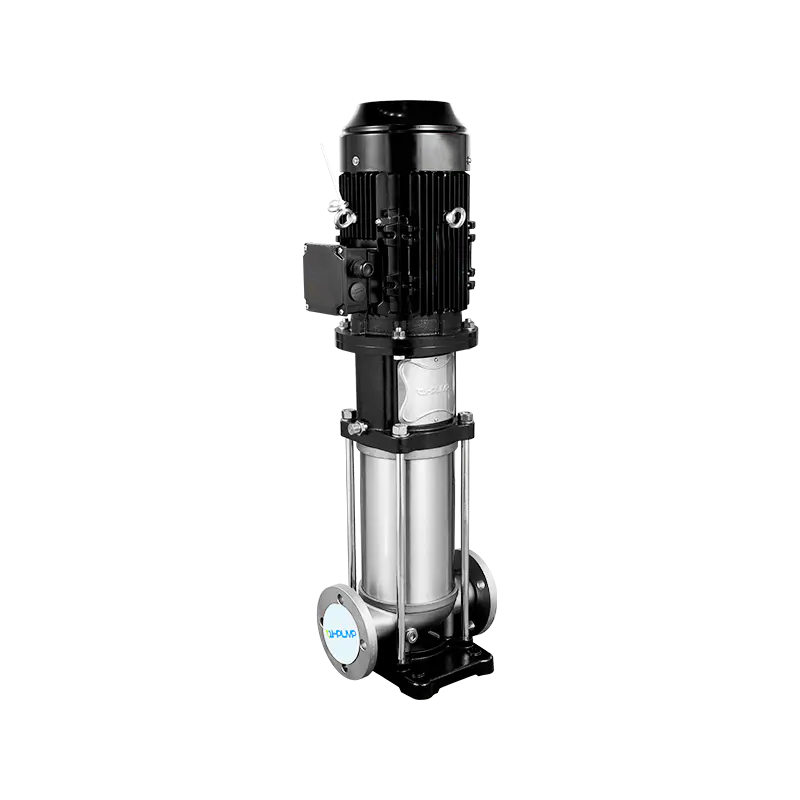
In a vertical multistage pump, the shaft and stacked impeller stages are oriented vertically, with the motor mounted directly above the pump on a shared axis. This inline, vertical configuration means the pump occupies a footprint roughly equal to the motor base alone — typically 60–75% less floor space than an equivalent horizontal multistage pump mounted on a baseplate with coupling and separate motor. This compact envelope makes vertical multistage pumps the default choice for building services, packaged booster sets, and any installation where plant room space is premium.
Structural and Hydraulic Features
- Inline pipework connection: Suction and discharge ports are typically on the same horizontal centerline, simplifying pipework layout and eliminating the need for offset connections that add friction losses and installation complexity.
- Self-venting design: The vertical orientation means air naturally rises out of the hydraulic passages during priming, making vertical multistage pumps inherently self-venting without external air release valves in most configurations.
- Low vibration transmission: The symmetric, balanced load path of a vertical inline pump transmits less vibration to connected pipework than a horizontally mounted unit, reducing noise in occupied buildings and fatigue stress on pipe joints.
- Direct-coupled motor: Most vertical multistage pumps use a close-coupled or semi-close-coupled motor arrangement with no external coupling, reducing mechanical losses, alignment requirements, and maintenance points.
Typical Operating Ranges
Commercial vertical multistage pumps cover flow rates from 1 m³/h to approximately 200 m³/h and heads from 20 m to over 600 m depending on stage count and impeller diameter. For larger flows, manufacturers offer parallel-pump booster configurations using two or more vertical multistage pumps on a common manifold, controlled by variable frequency drives to maintain constant pressure across variable demand profiles.
High Efficiency Vertical Multistage Pump: What Efficiency Means in Practice
Pump efficiency is the ratio of hydraulic power delivered to the fluid versus the shaft power consumed by the pump. For multistage pumps, overall efficiency is the product of hydraulic efficiency, volumetric efficiency (accounting for internal recirculation leakage), and mechanical efficiency (bearing and seal friction losses). A high efficiency vertical multistage pump typically achieves overall efficiencies of 70–82% at best efficiency point (BEP), compared to 55–65% for older or lower-grade designs.
This difference has substantial real-world cost implications. A pump operating continuously at 15 kW shaft input with 65% efficiency delivers 9.75 kW of hydraulic power. An equivalent high efficiency model at 78% efficiency delivers the same hydraulic power from only 12.5 kW shaft input — a 17% reduction in electrical consumption. Over 8,000 operating hours per year at €0.15/kWh, this efficiency improvement saves approximately €3,000 per year per pump — often recovering the cost premium of a high efficiency unit within 12–18 months.
Technologies That Enable High Efficiency in Vertical Multistage Pumps
- Hydraulically optimized impeller profiles: CFD-designed impeller blades with precise inlet and outlet angles matched to the design flow rate minimize hydraulic losses across the operating range. Leading manufacturers publish efficiency curves demonstrating BEP efficiency improvements of 3–6 percentage points over previous generation designs through impeller optimization alone.
- Reduced wear ring clearances: Tighter clearances between impeller wear rings and stage casings reduce internal recirculation leakage, improving volumetric efficiency. Stainless steel wear rings with controlled clearances of 0.15–0.25 mm maintain this efficiency advantage over extended service life.
- IE3 and IE4 premium efficiency motors: The motor represents the largest single loss element in the pump system. Pairing a hydraulically efficient pump with an IE3 (Premium Efficiency) or IE4 (Super Premium Efficiency) motor reduces total system losses by a further 2–4% compared to standard IE2 motors.
- Variable frequency drive (VFD) integration: Affinity laws dictate that pump power consumption scales with the cube of rotational speed. Reducing pump speed by 20% using a VFD reduces power consumption by approximately 49% — the most impactful single efficiency measure in variable-demand applications such as building water supply and HVAC pressure boosting.
Horizontal Multistage Pump: Where It Outperforms the Vertical Configuration
In a horizontal multistage pump, impeller stages are arranged in series along a horizontal shaft, with suction at one end and discharge at the other. The motor is connected via a flexible coupling on a shared baseplate. This configuration offers different strengths from its vertical counterpart — making it preferable in several demanding industrial and process applications.
Maintenance and Access Advantages
The horizontal layout gives maintenance engineers complete access to the mechanical seal, bearing assemblies, and shaft without disturbing pipework connections. Bearing housings are typically at both ends of the shaft, with the outboard bearing accessible for inspection and replacement without pump disassembly. In continuous process applications where maintenance access time directly affects production throughput, horizontal multistage pumps can reduce mean time to repair by 30–50% compared to close-coupled vertical designs where motor removal is required for internal access.
Higher Flow and Pressure Capability
Horizontal multistage pumps scale to larger shaft diameters, higher stage counts, and heavier-duty bearing arrangements than is practical in a vertical inline configuration. Industrial horizontal multistage pumps cover flow rates up to 2,000 m³/h and pressures exceeding 200 bar in standard configurations, serving applications such as boiler feed for power stations, high-pressure water injection in oil fields, and pipeline booster stations where vertical designs reach their practical limits.
Shaft Alignment and Coupling Considerations
The separate motor and coupling arrangement of a horizontal multistage pump introduces shaft alignment as an ongoing maintenance requirement. Misalignment of more than 0.05 mm parallel offset or 0.05 mm/100 mm angular offset causes accelerated bearing and seal wear, increased vibration, and shortened coupling life. Laser alignment tools are standard practice for horizontal multistage pump commissioning and should be repeated after any maintenance intervention or thermal settling period.
Vertical vs. Horizontal Multistage Pump: Direct Comparison
Both configurations use identical multistage hydraulic principles, but their mechanical arrangement creates distinct differences in installation requirements, maintenance characteristics, and application suitability. The table below summarizes the key decision factors.
| Criterion | Vertical Multistage Pump | Horizontal Multistage Pump |
|---|---|---|
| Floor Space Required | Very small (inline footprint) | Larger (baseplate + motor) |
| Pipework Layout | Inline — simplified | End suction/discharge — flexible |
| Maintenance Access | Motor removal often required | Full access without pipework disturbance |
| Max Practical Flow | ~200 m³/h (standard range) | Up to 2,000+ m³/h |
| Max Practical Pressure | Up to ~100 bar (standard) | Up to 200+ bar |
| Vibration and Noise | Lower (direct-coupled, balanced) | Higher without proper alignment |
| Alignment Requirement | None (close-coupled) | Laser alignment required |
| Typical Installation Cost | Lower | Higher (baseplate, grouting, alignment) |
Key Applications for Each Pump Configuration
Understanding the real-world application landscape clarifies which configuration is the natural fit for specific duties. In practice, the majority of building services, water treatment, and light industrial applications fall clearly into the vertical multistage category, while heavy process, power generation, and oil and gas duties typically require horizontal multistage designs.
Vertical Multistage Pump Applications
- Domestic and commercial water pressure boosting: Maintaining consistent supply pressure in mid-rise and high-rise buildings regardless of demand fluctuation. Systems of two or three vertical multistage pumps with VFD control and pressure sensor feedback are the standard solution in buildings from 5 to 40 floors.
- Reverse osmosis and water treatment: Delivering feed water at 6–15 bar to RO membrane arrays in municipal and industrial water treatment plants, where the compact footprint and low noise make vertical inline designs ideal for enclosed treatment buildings.
- HVAC pressurization and circulation: Maintaining system pressure in closed heating and chilled water circuits in commercial buildings, replacing older open expansion systems with sealed pressurized configurations.
- Irrigation and agricultural water supply: Boosting water from storage tanks or low-pressure mains to drip or sprinkler networks across large cultivation areas, particularly where multiple pump sets must be distributed across a site with minimal civil infrastructure.
Horizontal Multistage Pump Applications
- Boiler feed service: Delivering feedwater to steam generators at pressures from 30 to 180 bar in power stations, industrial steam plants, and district heating systems. Horizontal multistage pumps dominate this application due to their pressure capability and robust bearing design for continuous duty at elevated temperatures.
- Oil field water injection: Injecting produced water or seawater into reservoirs to maintain formation pressure during oil production. Injection pressures of 100–300 bar and continuous 24/7 operation make this one of the most demanding multistage pump duties, exclusively served by heavy-duty horizontal designs.
- Mine dewatering: Transferring large volumes of groundwater from mine levels to surface against heads of 200–600 m. Horizontal multistage pumps in this service are designed with hardened wear rings and special shaft seals to handle the abrasive particulate load in mine drainage water.
- Pipeline pressure boosting: Intermediate booster stations on long-distance water transmission mains, where pump stations may be separated by 30–60 km and must maintain pipeline pressure against elevation changes and friction losses across the full transmission distance.
Materials of Construction: Matching Pump Materials to the Fluid
Both vertical and horizontal multistage pumps are available in a range of wetted material configurations. For clean water and potable water service, stainless steel (AISI 304 or 316) impellers, stage casings, and shafts are the standard specification, providing corrosion resistance, compliance with drinking water regulations, and compatibility with chlorinated water treatment systems.
- AISI 304 stainless: Suitable for clean water, mildly hard water, and non-chloride-rich fluids. Standard for domestic water supply and irrigation applications. Lower cost than 316.
- AISI 316 stainless: Required for seawater, brackish water, chloride-rich groundwater, and most chemical process fluids. The molybdenum content resists pitting corrosion that 304 cannot withstand in chloride environments.
- Duplex stainless steel (2205): Specified for high-chloride, high-pressure service such as seawater injection in oil fields and desalination high-pressure pumping, providing superior strength and corrosion resistance at the cost of higher material and manufacturing cost.
- Cast iron with internal coating: Cost-effective for raw water and non-potable water in industrial applications where stainless steel is not required for corrosion resistance but chemical resistance of bare cast iron is insufficient.
Selecting Between Vertical and Horizontal Multistage Pumps: Decision Criteria
For most engineers and procurement professionals, the selection decision follows a clear hierarchy of factors. Answering these questions in sequence leads to the correct configuration choice in the majority of cases.
- Does the application require more than 200 m³/h flow or more than 100 bar pressure? If yes, the duty is outside standard vertical multistage pump ranges — specify a horizontal multistage pump and engage the manufacturer's application engineering team.
- Is floor space severely constrained? If yes, the vertical multistage pump's inline footprint provides a decisive installation advantage that horizontal designs cannot match.
- Is continuous 24/7 operation required with maximum maintainability? If yes, the accessible bearing and seal arrangement of a horizontal multistage pump reduces maintenance downtime risk in critical continuous process services.
- Is noise and vibration a concern? In occupied buildings, hospitals, laboratories, or noise-sensitive environments, the direct-coupled, low-vibration vertical multistage pump is preferable, particularly when paired with anti-vibration mounts.
- Is operating cost (energy efficiency) the primary driver? Specify a high efficiency vertical multistage pump with IE3/IE4 motor and VFD control for variable-demand applications. Commission an energy audit comparing specific energy consumption (kWh/m³) across competing models before specification.

Recommended Products
It is focused on the overall solution of dry bulk material port transfer system,
research and development, manufacturing, and service


 English
-
 Factory Area 5-6, No. 1118 Xin'an Road, Nanxun Town, Huzhou City, Zhejiang Province
-
 +86-4008117388
-
 [email protected]
Copyright © Zhejiang Zehao Pump Industry Co., Ltd. All Rights Reserved. Stainless Steel Multistage Centrifugal Pumps Manufacturers

