


 English
 中文简体
中文简体 русский
Industry News
Home / News / Industry News / Compact, Energy-Efficient & Low-Noise Vertical Multistage Pump: Engineering Guide

Mechanical rooms in commercial buildings are getting smaller. Energy codes are getting stricter. Residential and mixed-use developments increasingly demand quiet operation around the clock. And facilities teams — stretched thin — need equipment they can service without calling in a specialist for every inspection.
These four pressures have quietly reshaped what engineers and procurement teams look for when specifying a water supply pump. A unit that simply moves water at the required flow and head is no longer enough. The pump needs to do it in a confined space, at low running cost, without disturbing occupants, and without demanding constant attention. That combination of requirements points consistently to one pump type: the compact, energy-efficient, low-noise vertical multistage centrifugal pump.
This article breaks down each of those four advantages — not as marketing claims, but as engineering features with measurable consequences for installation cost, operating cost, and service life.
Content
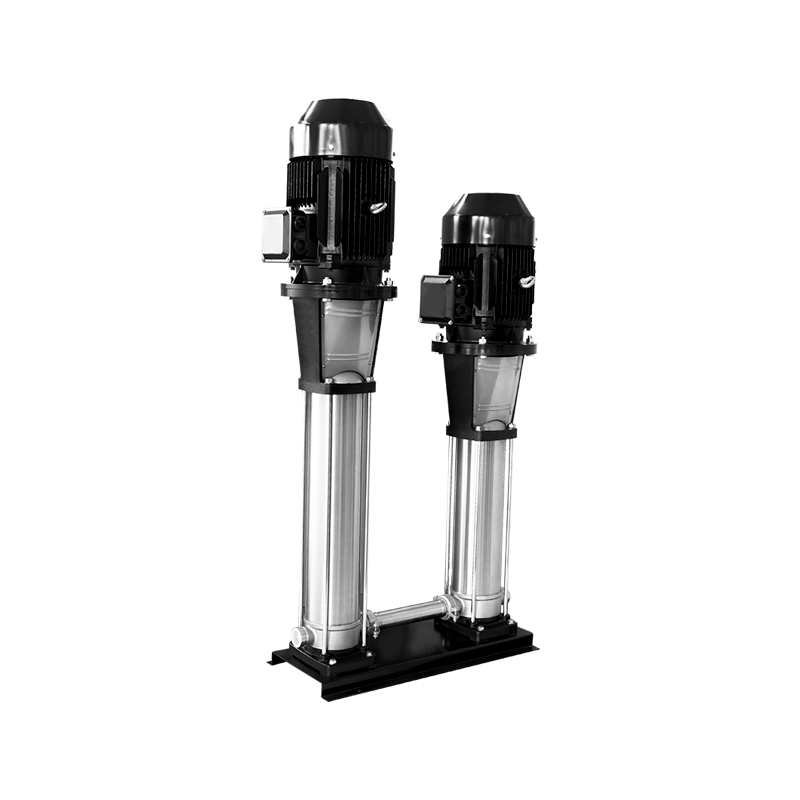
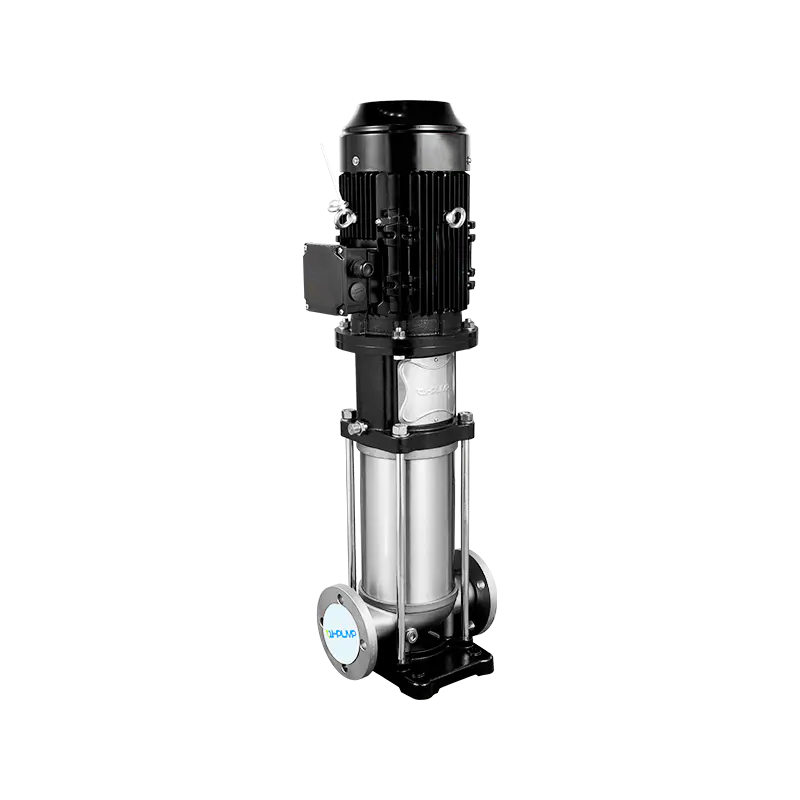
The vertical multistage centrifugal pump achieves its compact dimensions through a specific design choice: multiple impeller stages are stacked axially on a single shaft rather than arranged side by side as in a horizontal multistage layout. The pump's pressure-generating capacity scales with the number of stages, not with its horizontal spread. A unit delivering 100 meters of head occupies roughly the same floor area as one delivering 30 meters — the additional stages simply extend the shaft vertically.
In practical installation terms, this translates directly into real estate savings. A standard ZHLF-series unit typically occupies a floor footprint comparable to a 400×400 mm base, where an equivalent horizontal multistage installation might require two to three times that area plus additional clearance for shaft alignment access. In a basement plant room shared with switchgear, HVAC equipment, and fire suppression systems, those saved square meters matter.
The compact integrated structure also simplifies piping. With suction and discharge ports co-axially aligned in most vertical multistage configurations, the connecting pipework runs in a single plane rather than requiring offset bends to accommodate a horizontal pump casing. Fewer bends mean lower friction losses in the suction line — a direct benefit to net positive suction head (NPSH) margin — and faster installation with reduced labour cost.
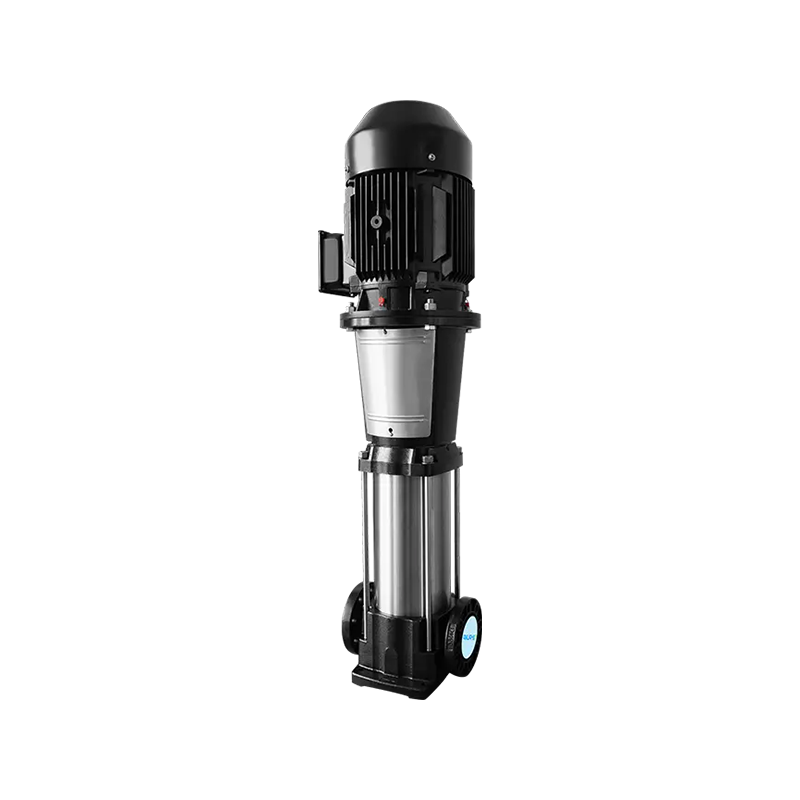
For projects with space-constrained mechanical rooms or process skids, the ZHLF series vertical multistage centrifugal pumps designed for building water supply applications offer standard footprints that fit within tight plant layouts without custom bases or extended pipework runs.
Energy efficiency in a centrifugal pump has two distinct sources: the hydraulic efficiency of the impeller design, and the motor efficiency of the drive unit. Both matter, and both are addressable in a well-specified vertical multistage pump.
On the hydraulic side, the multistage configuration itself contributes to efficiency. Each impeller stage operates at a moderate pressure differential, which is easier to achieve with low hydraulic losses than a single high-pressure stage trying to do the same work in one step. The result is a flatter best-efficiency point (BEP) curve and better part-load performance — useful in building water supply applications where demand varies continuously across the day.
On the motor side, modern vertical multistage pumps paired with IE3-class motors deliver meaningfully lower running losses than units equipped with standard-efficiency motors. The efficiency gain compounds over thousands of operating hours: a 5-percentage-point motor efficiency improvement on a 7.5 kW pump running 6,000 hours per year amounts to roughly 2,250 kWh saved annually — a figure that justifies the motor upgrade at almost any commercial energy tariff.
The largest efficiency gains, however, come from pairing the pump with a variable frequency drive (VFD). Water demand in buildings and industrial systems is rarely constant. A pump running at fixed speed against a throttling valve wastes the excess energy as heat and noise. A VFD-equipped pump reduces motor speed to match actual demand instead. Because centrifugal pump power consumption follows the cube law — halving speed reduces power consumption by a factor of eight — even moderate speed reductions deliver significant savings. Studies on VFD-controlled centrifugal pumps in water supply applications consistently show energy reductions of 20 to 50 percent compared to fixed-speed operation, depending on the load profile.
For applications where demand varies significantly — high-rise building water supply, industrial process water, reverse osmosis feed — the intelligent frequency conversion pump series built for variable-demand systems integrates VFD control directly into the unit, eliminating the need for a separate drive cabinet and simplifying commissioning. For applications requiring optimized hydraulic performance at a fixed duty point, the high efficiency vertical pump series with advanced hydraulic design delivers best-in-class impeller efficiency without the cost of an integrated drive.
Noise from pump installations has consequences beyond the discomfort of occupants near mechanical rooms. Persistent vibration transmitted through pipework causes fatigue in joints and hangers over time. Structural-borne noise in residential buildings generates tenant complaints and, in some markets, regulatory compliance obligations. And in hospitals, laboratories, and data centres, noise-sensitive environments place explicit upper limits on equipment sound pressure levels.
The low-noise performance of a well-designed vertical multistage pump comes from three concurrent design features, not one silver bullet.
First, hydraulic balance. The axially stacked impeller configuration generates radial hydraulic forces that largely cancel each other out across stages. This is fundamentally different from a single large impeller, where radial forces are concentrated at one point on the shaft and transmitted directly to the bearings and casing as vibration. Multi-stage hydraulic balancing reduces bearing load and extends bearing life simultaneously with reducing noise.
Second, mechanical seal design. Unlike older packed gland seals, modern mechanical seals run with essentially zero contact leakage and minimal friction-generated vibration. The seal faces ride on a thin fluid film rather than abrading against each other, which eliminates a significant secondary noise source that older pump installations exhibited.
Third, motor-pump coupling geometry. In a vertical multistage pump, the motor sits directly on top of the pump with a close-coupled shaft connection. There is no flexible coupling alignment to degrade over time, no belt drive to generate harmonic noise at belt-pass frequency, and no extended shaft span to develop resonant vibration. The drive train is short, stiff, and inherently damped by the fluid mass inside the pump casing.
The practical result is a pump that operates at sound pressure levels typically in the range of 60–72 dB(A) depending on size and speed — comparable to normal office background noise — rather than the 80–90 dB(A) levels associated with older horizontal multistage or split-case pump installations.
Pump maintenance costs are dominated not by parts costs but by labour and downtime. A mechanical seal replacement that takes four hours on a pump with good access costs two to three times as much on a pump that requires partial disassembly of surrounding pipework to reach the seal housing. Specifying for maintainability at the point of purchase is one of the most cost-effective decisions a facilities engineer can make.
Vertical multistage pumps with top-mounted motors address the access problem directly. Because the motor sits above the pump on the same vertical axis, the seal, bearings, and motor can all be accessed from above without disturbing the pipework connections at the pump's suction and discharge flanges. In a crowded plant room where adjacent equipment limits side access, this top-entry maintenance geometry is the difference between a two-hour seal replacement and a half-day job requiring partial decommissioning of neighbouring systems.
The modular stage construction of a multistage pump also simplifies repair. Each impeller stage is a standardized repeating unit. Replacing a worn stage — or adding a stage to increase head — requires disassembly of the stage stack from above, not removal of the entire pump from its pipework connections. Spare parts inventory is simplified because multiple pump models in a series often share identical stage components.
Stainless steel construction, standard on most modern vertical multistage pumps handling clean water, eliminates the surface rust and scale buildup that makes older cast iron pumps progressively more difficult to disassemble over their service life. Stainless impellers and casings come apart cleanly at maintenance intervals even after years of operation, without the corroded fasteners and seized fits that add unpredictably to service time on ferrous equipment.
For facilities teams managing multiple pump installations across a building or campus, the combination of top-entry access, modular stages, and stainless construction compresses the total maintenance burden to planned intervals of predictable duration — rather than the variable, often extended shutdowns that older pump designs generate.
The four advantages described above — compact structure, energy efficiency, low noise, and easy maintenance — reinforce each other most strongly in applications where at least two of the constraints (space, energy cost, noise sensitivity, maintenance access) are simultaneously active. The following table maps common applications to the advantages that drive the specification decision.
| Application | Space constraint | Energy priority | Noise sensitivity | Maintenance access |
|---|---|---|---|---|
| High-rise building water supply | High | High | High | Medium |
| Reverse osmosis feed pressure | Medium | High | Low | High |
| Industrial process water circulation | Medium | High | Low | High |
| Hotel / hospital water booster | High | Medium | High | Medium |
| HVAC chilled water makeup | High | Medium | High | Low |
| Boiler feedwater | Medium | Medium | Low | High |
| Fire suppression pressure maintenance | High | Low | Medium | Medium |
High-rise building water supply sits at the intersection of all four constraints and represents the most demanding specification environment for this pump type. The pump room is typically deep in a basement with fixed dimensions, energy costs in commercial buildings are under increasing regulatory scrutiny, upper floors require low-vibration transmission through the structure, and the building management team expects scheduled maintenance windows rather than emergency call-outs.
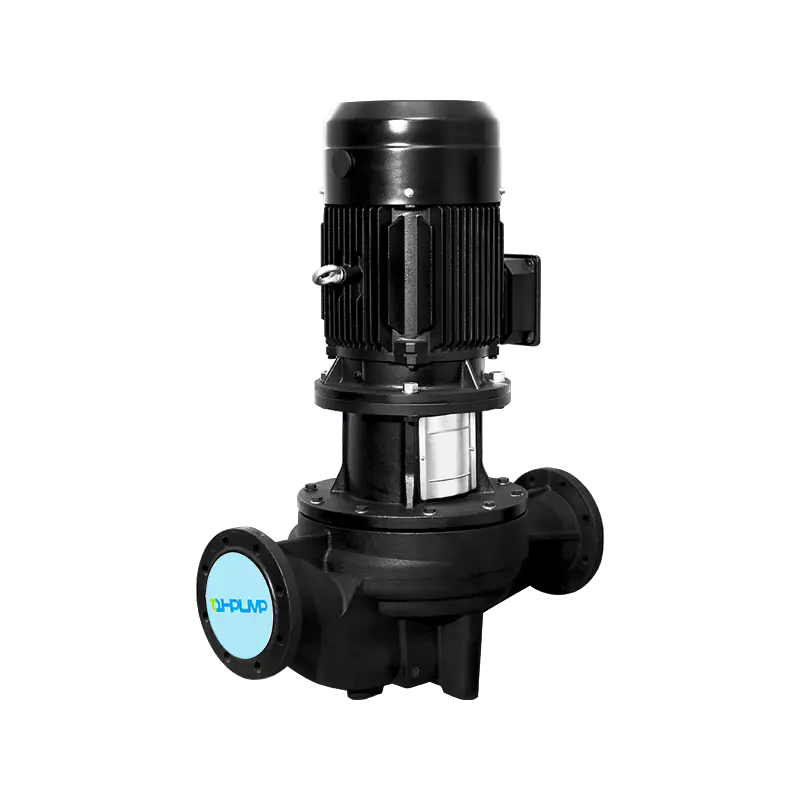
For circulation and pressure boosting within building systems, the pipeline pump series optimized for in-line pressure boosting and circulation complements vertical multistage units where the system requires distributed pressure support rather than a single centralized boost station.
Selecting the right pump for any of these applications starts with accurate flow rate, total dynamic head, and available NPSH data. Once those parameters are confirmed, the choice between standard-efficiency and high-efficiency hydraulic designs, and between fixed-speed and variable-frequency operation, determines the operating cost profile over the pump's service life. For most commercial and light industrial applications today, that analysis consistently favours the vertical multistage configuration over single-stage or horizontal alternatives — not because it is the newest technology, but because its design solves the constraints that actually govern modern pump installations.
It is focused on the overall solution of dry bulk material port transfer system,
research and development, manufacturing, and service
 Factory Area 5-6, No. 1118 Xin'an Road, Nanxun Town, Huzhou City, Zhejiang Province
 +86-4008117388
 [email protected]
Copyright © Zhejiang Zehao Pump Industry Co., Ltd. All Rights Reserved. Stainless Steel Multistage Centrifugal Pumps Manufacturers




 English